HVAC Training Duration: The Short Answer
You are thinking about a career change. You want a job that pays well, can’t be outsourced, and doesn’t require you to sit behind a desk for 40 hours a week. HVAC (Heating, Ventilation, and Air Conditioning) fits that bill perfectly.
But there is one big question standing between you and your first paycheck: How long is HVAC school?
You might have heard conflicting answers. Some say you can be done in a few months; others say it takes five years. The truth is, they are both right. It depends entirely on the path you choose.
If you just want the short answer: HVAC training typically takes anywhere from 6 months to 2 years.
However, “finishing school” and “being job-ready” are two different things. In this guide, we will break down the three main training paths, the real costs involved, and why your education doesn’t stop when you get your diploma.
📊 Is HVAC Right For You?
Before you commit to tuition, take a quick diagnostic quiz to see if you have the technical aptitude for the trade.
The 3 Main Paths: How Long Does HVAC Training Take?
When asking “how long is hvac training,” you need to choose between speed, depth, or the “earn-while-you-learn” model. Here are the three standard routes in the US:
1. Certificate Programs (The Fast Track: 6-10 Months)
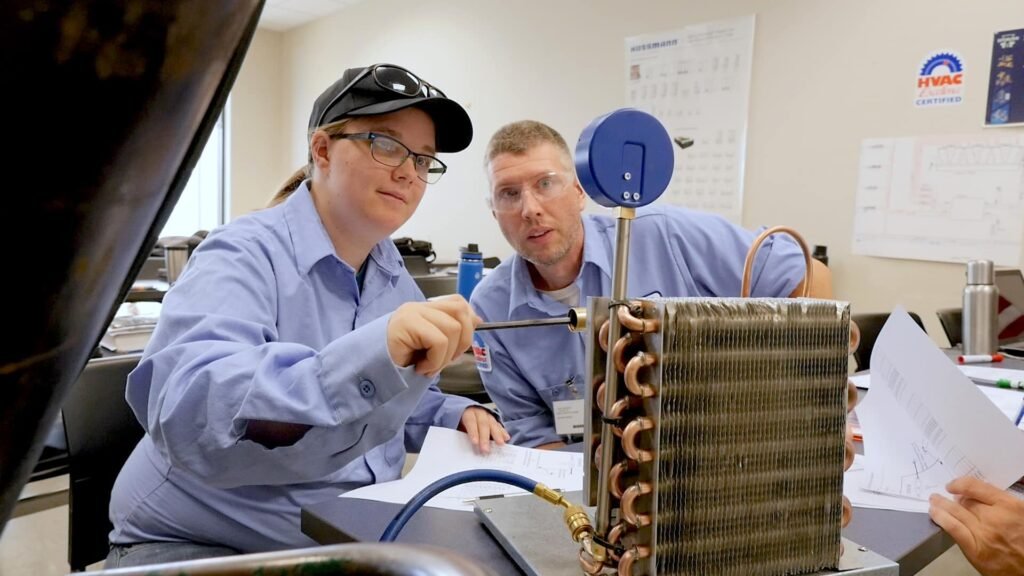
This is the most popular option for career switchers. Offered by private trade schools or technical institutes, these programs cut out all the “fluff” (like English or History classes) and focus 100% on the trade.
- Duration: 6 to 10 months.
- Curriculum: Basic electricity, refrigeration cycle, heating systems, and brazing.
- Pros: Fastest way to enter the workforce.
- Cons: Tuition can be expensive ($12,000 – $20,000+), and you might miss out on deeper theory.
2. Associate Degree (The Comprehensive Route: 2 Years)
Community colleges offer an Associate of Applied Science (A.A.S.) in HVAC-R technology.
- Duration: 2 years (4 semesters).
- Curriculum: Includes everything in the certificate program plus blueprint reading, advanced commercial systems, and general education courses.
- Pros: Cheaper than private trade schools; credits can transfer to a bachelor’s degree; better prepared for management roles later.
- Cons: Takes twice as long before you start making money.
3. Apprenticeship (The “Earn While You Learn” Route: 3-5 Years)
This is the traditional path, often managed by unions (like the UA) or non-union associations (like ABC). You work full-time during the day and take classes at night or on weekends.
- Duration: 3 to 5 years.
- Curriculum: On-the-job training combined with classroom theory.
- Pros: You graduate with zero debt. In fact, you are paid a salary from Day 1.
- Cons: Highly competitive to get in. The schedule is grueling (work all day, school at night).
Online HVAC Classes: Can You Speed It Up?
In 2026, many students are asking: how long are hvac classes if I take them online? Can I finish faster?
The answer is yes, but with a catch.
Online programs (like Penn Foster or SkillCat) allow you to complete the theoretical portion of the training at your own pace. If you treat it like a full-time job, you could potentially finish the coursework in 3 to 4 months.
However, HVAC is a tactile trade. You cannot learn how to feel the difference between a suction line and a liquid line through a computer screen. Most employers will still require you to demonstrate hands-on competence before letting you in a service van.
Our Advice: If you choose online training, use it to pass your EPA 608 Certification quickly, then try to get hired as a “helper” immediately to get the hands-on experience.
🛠️ Don’t Just Watch Videos
Online classes teach theory, but exams test specific scenarios. Try a simulation question to see if you really understand the refrigeration cycle.
The Real Finish Line: Certification (Not Just Graduation)
Here is a secret schools don’t always tell you: Graduating does not make you a technician. Certifications do.
You can spend 2 years in school, but if you don’t pass the EPA 608 exam, you legally cannot handle refrigerants. You are unemployable as a technician.
Furthermore, if you want to command a higher salary right out of the gate, you should look into the NATE (North American Technician Excellence) certification. While school teaches you the basics, certifications prove you know the industry standards.
Related Guide: The Ultimate NATE Certification Prep Guide
Many students make the mistake of waiting until they graduate to start studying for these exams. Do not wait. Use your time in school to use exam prep apps and secure these licenses before you start job hunting.
Is HVAC School Worth the Time and Cost? (ROI Analysis)
Let’s look at the numbers. Is it worth spending $15,000 and 10 months of your life?
According to the Bureau of Labor Statistics (BLS), the median pay for HVAC mechanics is over $57,000/year, with top earners making over $80,000.
Here is a simple ROI (Return on Investment) comparison:
| Path | Avg. Cost | Time to Income | Est. Starting Pay |
| Certificate | $15,000 | 9 Months | $18 – $22 / hr |
| Associate Degree | $10,000 (Community College) | 2 Years | $20 – $24 / hr |
| Apprenticeship | $0 (Tools only) | Immediate | $16 – $20 / hr |
| 4-Year College | $100,000+ | 4 Years | Varies |
Unlike a university degree where you might graduate with massive debt and no specific job skills, HVAC school offers a direct path to employment. The demand is massive. How long is hvac school? Short enough that you can change your life in less than a year.

Conclusion: Which Path Should You Choose?
So, how long is hvac school for you?
- If you need a job ASAP, go for a Certificate Program.
- If you want to save money and eventually move into management or engineering, go for an Associate Degree.
- If you can find a sponsor and want zero debt, fight for an Apprenticeship.
Whichever path you choose, remember that school is just the beginning. The real test comes when you sit for your state licensing and EPA exams.
Ready to get ahead of your class?
Don’t rely solely on your textbooks. Start building your exam-taking confidence today with our dedicated practice tools.
📱 Turn Downtime Into Study Time
Access 1,000+ EPA & NATE exam questions directly in your browser. Perfect for studying between classes.


0 Comments