The Reality of HVAC Pay: Is It Worth It?
Let’s be real. You aren’t crawling into 130-degree attics or hauling compressors up icy rooftops just for the fun of it. You are doing it for the paycheck.
Whether you are a complete beginner looking to enter the trade or a seasoned pro looking to renegotiate your wages, understanding the current hvac technician salary landscape is critical.
The good news? The HVAC industry is “recession-proof.” Buildings always need heating and cooling, regardless of the economy.
The better news? In 2026, the demand for skilled technicians is at an all-time high, driving wages up significantly.
But “average” numbers can be misleading. A technician in rural Alabama makes a very different wage than a union journeyman in New York City. In this guide, we will break down the real numbers by state, experience level, and the specific certifications that can add $20k+ to your annual income.
📊 What Are Your Skills Worth?
Salary is tied to skill. Do you know your electrical theory and refrigeration codes? Take a quick quiz to find out.
National Average vs. Reality
According to the latest data from the Bureau of Labor Statistics (BLS), the median annual wage for HVAC mechanics and installers is approximately $57,300 per year (about $27.55 per hour).
However, “Median” means half make less, and half make more. It doesn’t tell the full story.
- The Bottom 10% (Helpers/Apprentices): Earn less than $37,000.
- The Top 10% (Master Techs/Commercial): Earn more than $84,000.
If you specialize in commercial refrigeration or join a strong union, that top number can easily exceed $100,000.
Salary Breakdown by Experience Level
Your paycheck grows as your skills grow. Here is the typical career trajectory for hvac technician salaries in 2026:
1. Apprentice / Helper (0-2 Years)
- Average Pay: $18 – $24 per hour
- Role: Fetching tools, cleaning coils, learning the basics.
- Requirement: EPA 608 Certification is usually required to get hired.
- Learn more in our Apprentice Jobs Guide.
2. Journeyman / Lead Tech (3-6 Years)
- Average Pay: $28 – $45 per hour
- Role: Running service calls independently, performing complex installs, training apprentices.
- Requirement: State Journeyman License and NATE Certification.
- Learn more in our Journeyman License Guide.
3. Master Technician / Specialist (7+ Years)
- Average Pay: $45 – $70+ per hour
- Role: Commercial Rack Systems, Chillers, Controls Specialist, or Business Owner.
- Requirement: Master License, extensive specialized training.
Highest Paying States for HVAC Techs
Where you live determines what you make. If you are willing to relocate, you can significantly boost your hvac technician salary.
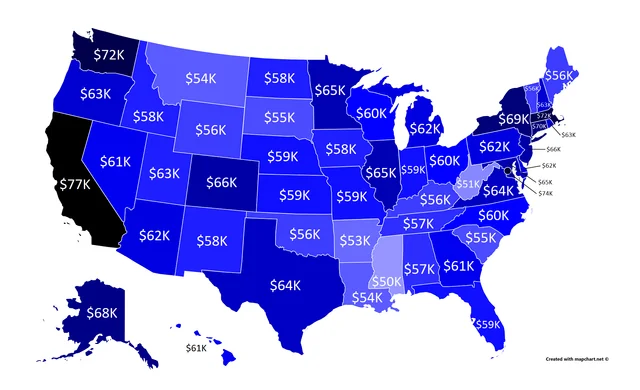
Based on 2025/2026 data, these are the top 5 states for HVAC wages:
- Alaska: $85,000+ (High demand due to extreme cold).
- California: $78,000+ (Strong unions and high cost of living).
- Massachusetts: $76,000+ (Commercial/Industrial focus).
- Washington: $74,000+.
- Hawaii: $73,000+.
Note: While these states pay more, they also have a higher cost of living. Florida and Texas are also excellent markets due to the sheer volume of air conditioning work required year-round.
4 Factors That Influence Your Pay
Why does one tech make $20/hr and another make $50/hr? It comes down to four variables.
1. Commercial vs. Residential
Residential work (homes) is steady, but Commercial/Industrial work (offices, factories, supermarkets) pays about 20-30% more. Commercial systems are more complex and the clients have deeper pockets.
- Read more: Commercial Refrigeration Career Path.
2. Union vs. Non-Union
Joining a union (like the United Association) guarantees a set pay scale, pension, and benefits. Non-union shops offer more flexibility but often lower starting pay. Union hvac technician salaries are typically higher over a lifetime career.
3. Overtime & On-Call
HVAC is not a 9-to-5 job. Summer heatwaves and winter freezes mean long hours. Techs willing to work “on-call” weekends and overtime can double their base salary during peak seasons.
4. Certifications (The Big One)
This is the one factor you can control right now.
Employers pay for knowledge. A technician with a Universal EPA 608 and NATE Certification is worth far more than a tech with no credentials.
- EPA 608: Mandatory. You can’t work without it.
- NATE: Voluntary. It proves you are an expert troubleshooter.
🛠️ Certifications = Higher Pay
Don’t leave money on the table. Techs with NATE certifications earn up to 20% more. Start practicing for your exam today.
How to Ask for a Raise (And Get It)
If you are already working and feel underpaid, don’t just ask for more money. Show your value.
- Get Certified: Walk into your boss’s office and say, “I just passed my NATE Core exam.” That is leverage.
- Expand Your Toolkit: Show that you have invested in professional HVAC Tools and know how to use them efficiently.
- Reduce Callbacks: Use proper diagnostic procedures (Subcooling/Superheat) to fix units right the first time.

Conclusion: The Sky is the Limit
The question “what is hvac technician salary” has many answers. You can be a $40k/year parts changer, or you can be a $120k/year diagnostic expert. The difference lies in your education and certifications.
The industry is hungry for skilled professionals. If you are willing to learn the code, master the electrical theory, and get certified, you will never have to worry about your paycheck again.
Ready to boost your earning potential?
Stop guessing and start studying. Our comprehensive practice tests help you pass the exams that lead to the highest paying jobs in the industry.
📱 Turn Downtime Into Study Time
Access 1,000+ exam questions directly in your browser. Pass your certification exams and level up your career.



0 Comments