Building Your First HVAC Tool Kit
Walking into a supply house as a new technician can be overwhelming. There are thousands of shinys gadgets, and every salesperson will tell you that you “need” them all. But if you are just starting out, buying everything at once is the fastest way to go broke.
A professional hvac tools kit is built over time, not bought in a day.
However, there is a core set of equipment you cannot do your job without. Whether you are troubleshooting a furnace in a blizzard or checking refrigerant charges on a rooftop in July, your tools are your lifeline.
But here is something most trade schools won’t tell you: Owning the tools is the easy part. Knowing the physics behind them is what gets you certified.
In this guide, we will break down the essential hvac tools you need for 2026, and more importantly, how these tools are tested on the EPA 608 and NATE exams.
📊 Quiz: Do You Know Your Tools?
Can you identify the correct tool for measuring deep vacuum? Take a quick quiz to test your knowledge.
The “Must-Have” Hand Tools (Day 1 Essentials)
Before you touch a refrigerant line, you need the basics. These are the tools you will carry in your bag every single day.
- Service Wrench (Refrigeration Wrench): This is a specialized ratcheting wrench for opening and closing service valves on compressors. You cannot do the job without it.
- Nut Drivers (1/4” and 5/16”): 90% of the screws in the HVAC world are either 1/4 or 5/16 hex head. Buy the magnetic ones; you will thank me when you drop a screw in the snow.
- Aviation Snips: You need “Reds” (Left cut), “Greens” (Right cut), and “Yellows” (Straight cut) for sheet metal work.
- Inspection Mirror: Essential for reading model numbers on the back of units or checking brazing joints in tight spots.
Exam Tip: On the NATE Core exam, you may be asked about tool safety. For example, knowing which screwdriver to use to avoid stripping a screw head, or ladder safety when carrying tools to a roof.
Diagnostic Tools: The Exam Heavyweights
This is where the “Technician” part comes in. These tools measure the invisible forces—electricity, pressure, and temperature. These are also the tools that appear most frequently on certification exams.
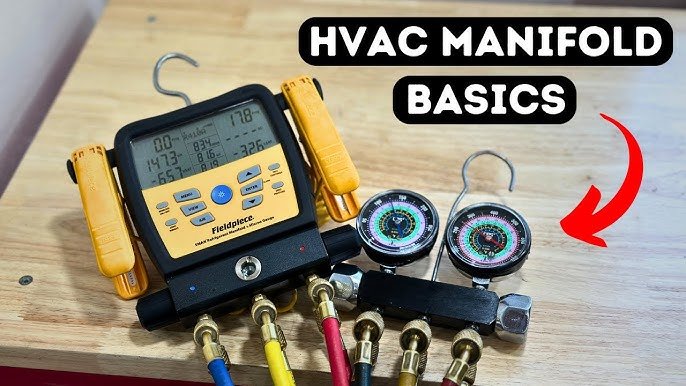
1. Manifold Gauges (Analog vs. Digital)
This is the icon of the trade. You use them to check refrigerant pressures, charge systems, and diagnose issues.
- Analog: The classic needle gauges. Great for learning, but you have to manually calculate saturation temperatures using a PT Chart.
- Digital: Automatic calculations for Superheat and Subcooling. Expensive, but efficient.
Exam Context: On the EPA 608 exam, you won’t have digital gauges. You must know how to read a Pressure-Temperature chart manually to determine if a system contains air or non-condensables.
2. Multimeter (Electrical Meter)
If you can’t use a meter, you can’t fix ACs. You need a meter that measures:
- Voltage (Volts AC/DC): To check if power is present.
- Resistance (Ohms): To check for open or shorted windings.
- Capacitance (MFD): To check run capacitors.
- Amperage (Amps): To check motor load.
Exam Context: A classic NATE question asks: “If you measure 24V across a switch, is the switch Open or Closed?” (Answer: Open). Our App has hundreds of these electrical scenario questions.
3. Thermometer & Psychrometer
You need to measure temperature difference (Delta T) across the evaporator coil. A psychrometer measures Wet Bulb temperature, which is critical for calculating target superheat.
🛠️ Can You Read the Meter?
Scenario: Your meter reads “OL” when checking a compressor winding. What does that mean? Test your diagnostics skills now.
Specialized Tools for Recovery & Evacuation
Since the EPA mandates strict refrigerant handling, you need specific hvac tools to stay legal.
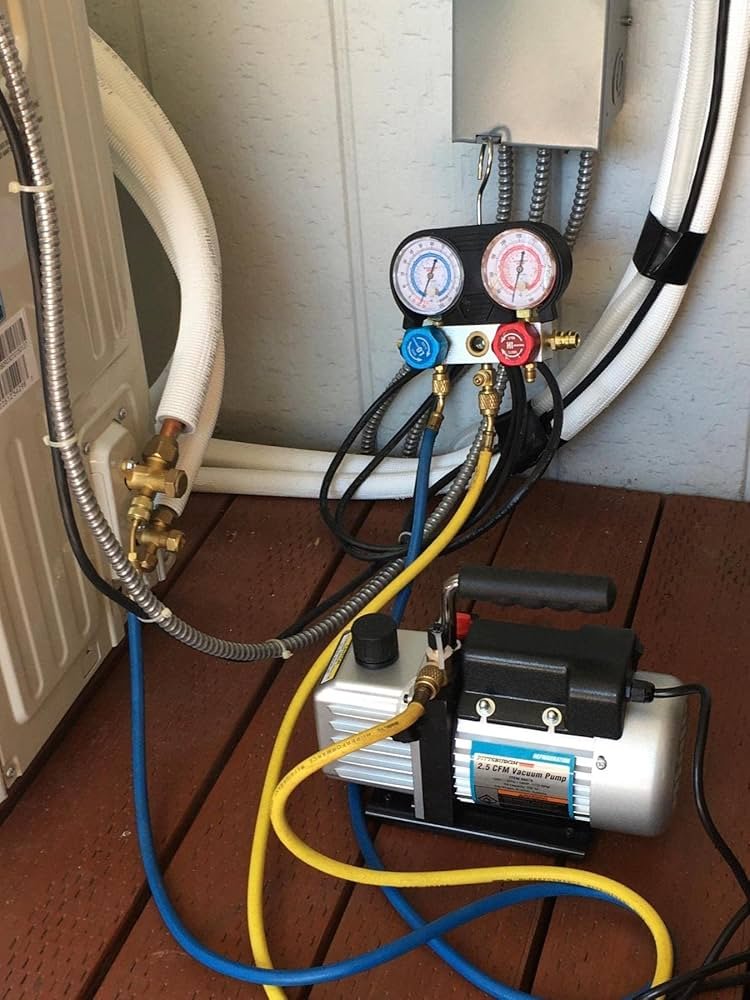
1. Vacuum Pump & Micron Gauge
You cannot just rely on your manifold gauges to pull a vacuum. You need a Micron Gauge.
- The Rule: A system is considered dehydrated when it holds a vacuum of 500 microns or less.
- The Trap: Analog gauges cannot read microns accurately. If you guess, you leave moisture in the system, which turns into acid.
2. Recovery Machine
You are legally required to recover refrigerant into a certified tank; you cannot vent it.
- EPA Connection: The EPA regulations specify evacuation levels (e.g., 0 inches Hg, 10 inches Hg, or 15 inches Hg) depending on the appliance type. Your recovery machine must be rated to meet these standards.
Tools vs. Knowledge: Don’t Fail the Exam
Here is the hard truth: Buying a $500 digital manifold won’t help you pass the written exam.
The certification exams (NATE, EPA, Journeyman) test your understanding of the principles, not your budget. They want to know if you understand why Subcooling indicates a flooded condenser, not just that your digital tool says “10 degrees.”
We often see technicians who have thousands of dollars in tools but fail the exam because they rely too much on technology and forgot the fundamentals.
The Best Tool in Your Kit? Your Brain.
Before you spend your first paycheck on a shiny new leak detector, invest in your knowledge. Understanding the IMC Codes and electrical theory will pay you dividends for the rest of your career.
Conclusion
Building your hvac tools collection is an exciting part of entering the trade. Start with the basics, buy quality brands (like Klein, Fieldpiece, or Yellow Jacket), and upgrade as you earn.
But remember, a multimeter is useless if you don’t know Ohm’s Law.
Ready to sharpen your mental tools?
Access our comprehensive question bank to ensure you know how to use these tools safely and correctly according to industry standards.
📱 Turn Downtime Into Study Time
Access 1,000+ tool safety and usage questions directly in your browser. No downloads required.

0 Comments