The Reality of Becoming an HVAC Technician
If you are thinking about trading your desk job for a pair of work boots, you probably have one burning question: Is HVAC hard to learn?
You’ve heard the stories. You’ve heard about the 130-degree attics, the complex electrical diagrams, and the heavy lifting. You might be worried that you aren’t “good at math” or that you’re starting too late.
Here is the honest truth from the field: HVAC is one of the most difficult trades to master, but it is also one of the most rewarding.
It is not just about turning a wrench. It is a unique combination of electrical engineering, plumbing, physics, and construction work—all performed in extreme weather conditions.
In this guide, we aren’t going to sugarcoat it. We will break down exactly what makes it hard, and how you can overcome the steep learning curve to build a six-figure career.
📊 Identify Your Strengths
Are you better at mechanical logic or electrical theory? Take our aptitude quiz to find your natural fit in the trade.
Part 1: The Mental Game (Is HVAC Hard to Learn?)
When people ask “is hvac hard to learn,” they are usually worried about the “book smarts.”
Unlike plumbing (which is largely about flow and gravity) or carpentry (measure and cut), HVAC requires you to understand invisible forces: Electricity and Thermodynamics.
The Electrical Barrier
This is where 50% of students drop out. You cannot see electricity, but you have to control it.
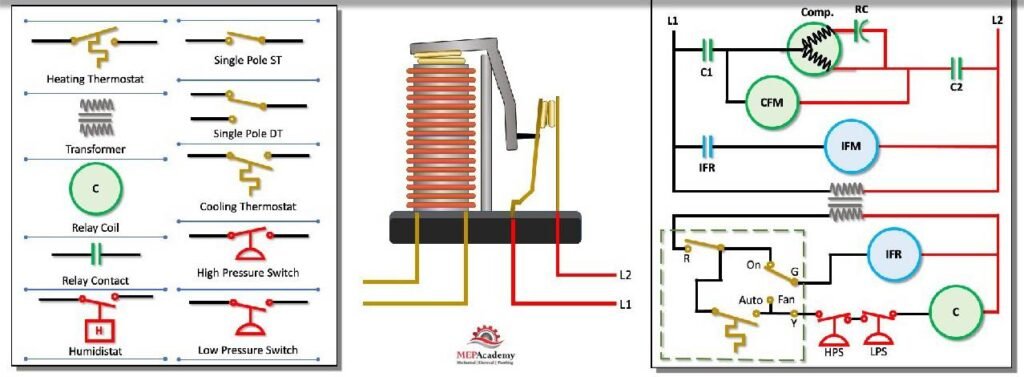
- You need to read schematic diagrams that look like a bowl of spaghetti.
- You need to understand Low Voltage (24V controls) vs. High Voltage (120V/240V power).
- One wrong wire can fry a $500 circuit board—or hurt you.
The Physics (Thermodynamics)
You don’t need Calculus, but you do need Physics. You must understand how pressure affects temperature.
- Why does compressing a gas make it hot?
- Why does expanding a liquid make it cold?
- If you can’t grasp the Refrigeration Cycle, you will never be more than a “parts changer.”
Part 2: The Physical Grind (Is HVAC a Hard Job?)
Beyond the classroom, is HVAC a hard job physically? Yes.
There is a saying in the trade: “HVAC technicians are paid for what they know, but they earn it with their backs.”
1. The Environment
Your “office” changes every day.
- Summer: You are in attics that reach 130°F+. You are sweating through your clothes in 10 minutes.
- Winter: You are on commercial rooftops with wind chills below zero, trying to handle screws with frozen fingers.
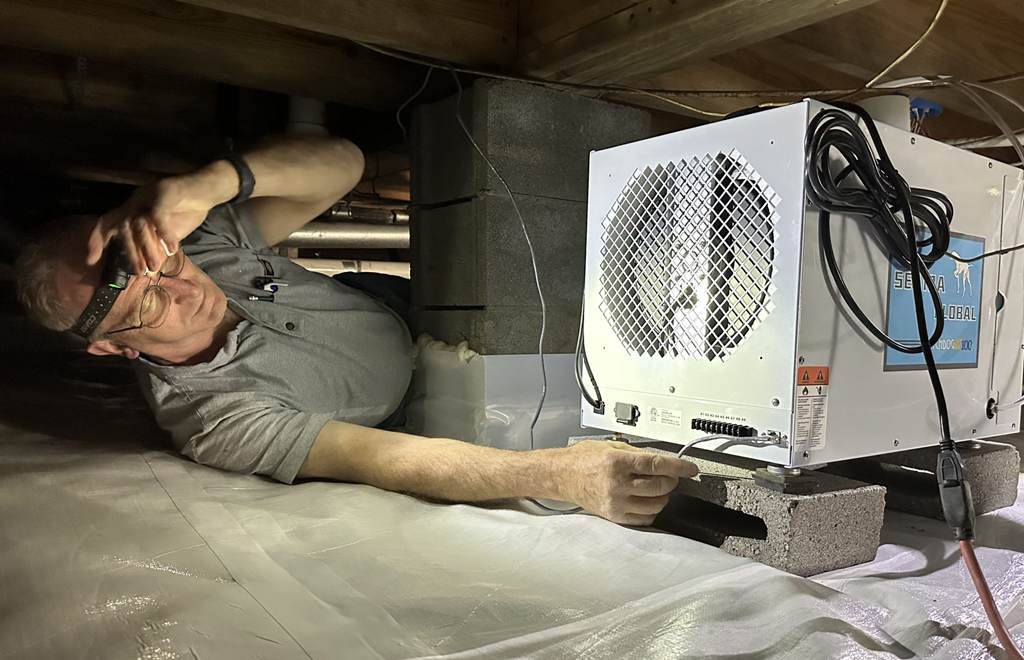
- Crawlspaces: You will be belly-crawling through dirt, spiderwebs, and insulation to reach a furnace.
2. The Heavy Lifting
Compressors weigh 80+ lbs. Furnaces are awkward and sharp. You will be carrying heavy tool bags up and down ladders all day.
The Reality Check: If you are claustrophobic or afraid of heights, this is not the career for you. But if you hate sitting still and love a physical challenge, it keeps you in great shape.
Part 3: The Math Myth (How Hard is HVAC Math?)
This is the biggest fear for most career switchers. * “I was bad at math in high school. Can I do this?”*
The good news: You do not need to be a mathematician.
Is HVAC hard to learn because of math? No. The math is practical. You aren’t solving abstract equations; you are solving real problems.
The math you actually use:
- Ohm’s Law:
E=I×RE=I×R(Basic multiplication). - Subcooling/Superheat: Simple subtraction (Temperature A – Temperature B).
- Airflow (CFM): Basic area calculation (Length x Width).
Today, digital tools and apps do most of the heavy lifting for you. You just need to understand the concepts, not do long division on a rooftop.
🛠️ Test Your “Applied Math”
Don’t let the numbers scare you. Try a simple Subcooling calculation question in our simulator. It’s easier than you think.
The Learning Curve: School vs. The Field
So, how hard is HVAC to actually get started? The barrier to entry is relatively low compared to the skill ceiling.
- Year 1 (The “Sponge” Phase): You will feel stupid. You will hand the wrong tool to your lead tech. This is normal. Your job is to learn safety and basic parts.
- Year 2-3 (The “Click” Phase): Suddenly, electricity makes sense. You can diagnose a bad capacitor without calling your boss.
- Year 5+ (The Master Phase): You are now solving problems that stump other techs.
According to industry training experts, the fastest way to shorten this learning curve is simulation.
You can’t practice fixing a broken compressor in the field (customers get mad if you experiment). But you can practice on a simulator.
Is It Worth It? (Difficulty vs. Reward)
If it were easy, everyone would do it, and it wouldn’t pay well.
The fact that HVAC is hard to learn is exactly why it is a secure career.
- Job Security: You cannot outsource a furnace repair to overseas. AI cannot climb a ladder.
- High Pay: Because fewer people are willing to do the hard work, supply is low and demand is high. See our full HVAC Salary Guide for details.
- Satisfaction: There is a unique feeling when you walk into a 90-degree house, fix a complex electrical fault, and feel the cool air kick on. You are a hero.
Conclusion: How to Make It Easier
So, is hvac hard to learn? Yes. It requires grit, brainpower, and thick skin.
But you don’t have to learn it the hard way.
Most people struggle because they rely on boring textbooks or “trial and error.”
The Cheat Code:
Combine your field experience with digital practice tools. Use apps to visualize the electrical circuits and memorize the EPA regulations without the stress.
Ready to accept the challenge?
If you are willing to put in the work, we have the tools to help you master the theory.
📱 Master the Hard Stuff Faster
Struggling with electrical theory? Our app breaks down complex HVAC concepts into bite-sized practice questions.


0 Comments