The Reality of Passing the EPA 608 Exam
Are you looking for a reliable epa 608 practice test to help you pass your certification on the first try? You are in the right place.
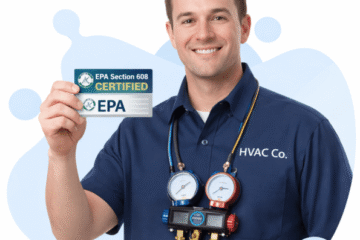
If you want to work in the HVAC industry, there is one hurdle you absolutely cannot skip: The EPA 608 Certification. Unlike other voluntary certifications, this one is federal law. Without that card in your wallet, you cannot legally buy refrigerants, and you certainly cannot get hired by a reputable company.
But here is the reality: The pass rate for first-time test-takers is lower than you might think. Why? Because the exam requires memorizing specific dates, definitions, and leak rate percentages that you might not use every day in the field.
Are you ready to prove your knowledge? In this guide, we will break down the trickiest parts of the exam and provide a realistic epa 608 practice test strategy to help you earn your Universal Certification.
📊 Do You Know the 2026 Rules?
Leak rates changed recently. Take a quick diagnostic quiz to see if your knowledge is up to date.
Why the EPA 608 is the “Gatekeeper” of HVAC
The Environmental Protection Agency (EPA) requires this certification under Section 608 of the Clean Air Act. Its primary goal is to prevent the release of ozone-depleting substances (like CFCs and HCFCs) and greenhouse gases (like HFCs) into the atmosphere.
For a technician, this means you must demonstrate that you know how to recover, recycle, and reclaim refrigerants responsibly.
There are four types of certification:
- Type I: Small Appliances (5 lbs of refrigerant or less).
- Type II: High-Pressure Appliances (Residential AC, Heat Pumps, Commercial).
- Type III: Low-Pressure Appliances (Chillers).
- Universal: Passing all three above + the Core exam.
The Goal: You want the Universal Certification. It makes you more valuable to employers because you can work on any system. To get it, you need a comprehensive epa 608 practice test that covers every single section.
The “Trap” Questions: Where Most Techs Fail
The EPA exam is infamous for having “trap” questions. These are questions that look easy but rely on memorizing exact numbers or dates. If you rely on “common sense,” you will fail.
1. The Leak Rate Thresholds (Memorize This!)
This is the #1 area where technicians lose points. The EPA updated these rules (effective Jan 1, 2019), but many old study guides still list the old numbers.
Current Maximum Leak Rates (for systems with 50+ lbs of refrigerant):
- Industrial Process Refrigeration: 30%
- Commercial Refrigeration: 20%
- Comfort Cooling (Residential/Office): 10%
If a system leaks more than this within a 12-month period, it must be repaired. A good epa 608 practice test will present you with a scenario (e.g., “A supermarket rack system…”) and ask you to apply the correct percentage.
2. The Montreal Protocol Dates
You will be asked about the dates when certain refrigerants were banned or when recovery equipment standards changed.
- July 1, 1992: Violation to vent CFCs or HCFCs.
- November 15, 1993: Recovery equipment must be certified by an EPA-approved lab.
- November 15, 1995: Violation to vent HFCs.
These dates are dry and boring, but they are guaranteed points on the exam if you use flashcards to memorize them.
Sample EPA 608 Practice Questions (With Explanations)
Let’s look at a few examples from our question bank to see how prepared you really are.
Core Exam Question: Ozone Depletion
Q: Which refrigerant has the highest Ozone Depletion Potential (ODP)?
A. R-410A (HFC)
B. R-22 (HCFC)
C. R-12 (CFC)
D. R-1234yf (HFO)
Correct Answer: C (R-12)
Explanation: CFCs (Chlorofluorocarbons) like R-11 and R-12 contain Chlorine, which is the primary cause of ozone depletion. HFCs and HFOs do not contain Chlorine, so their ODP is zero.
Type II Exam Question: System Evacuation
Q: After installation of a field-piped split system, the unit should first be:
A. Pressurized with nitrogen and leak checked.
B. Evacuated to 500 microns.
C. Charged with R-410A immediately.
D. Pressurized with oxygen.
Correct Answer: A
Explanation: Before evacuation (pulling a vacuum), you must ensure the system is tight. You pressure test with dry nitrogen first. Never use oxygen, as it can cause an explosion when mixed with oil. This is a critical safety question found in every epa 608 practice test.
🛠️ Test Your Knowledge
Can you identify which recovery technique is required for a Type III low-pressure chiller? Try a practice question now.
Strategy: Closed-Book vs. Open-Book
Unlike the <a href=”https://hvacexammaster.com/hvac-journeyman-license-guide/”>Journeyman License exam</a> which allows you to bring code books, the EPA 608 exam is Closed Book.
This means you cannot bring notes, cheat sheets, or PT charts into the testing center. You must have the Pressure-Temperature relationships memorized (or know how to read the provided saturation chart quickly).
The “Memory Dump” Technique:
As soon as the exam starts and you are given scratch paper, write down the key numbers you memorized (like the 10/20/30 leak rates and the 10/15/25 inch Hg vacuum levels). This clears your brain and gives you a reference sheet to use during the test.

Why Online Practice Tests Are Better Than PDFs
In the past, techs studied using static PDF guides. The problem? PDFs don’t tell you why you got an answer wrong.
Modern tools like our HVAC Exam Master App use active learning.
- Instant Feedback: You see the explanation immediately after answering.
- Weakness Tracking: The app notices if you are failing “Type I” questions and automatically gives you more of them until you improve.
- Updated Content: The EPA regulations change (like the recent AIM Act regarding HFC phase-downs). A textbook from 2018 is already obsolete.
For a deeper dive into the specific certification details, check out our EPA 608 Study Guide Page.
Conclusion
Getting your EPA 608 card is the first step to a long and profitable career. It might seem like a lot of regulations to memorize, but with the right epa 608 practice test routine, you can pass it in a weekend of dedicated study.
Don’t risk failing and having to pay the proctor fee again. Start practicing with questions that mirror the actual exam difficulty.
Ready to get certified?
Access our full database of Core, Type I, II, and III questions directly from your phone.
📱 Turn Downtime Into Study Time
Access 600+ EPA exam questions directly in your browser. No downloads required, perfect for studying between jobs.

0 Comments