Cracking the Code: Why Low Voltage Matters
Ask any seasoned service manager what causes the most callbacks, and they will give you the same answer: electrical issues. Whether you are swapping out a bad control board on a gas furnace or rescuing a homeowner who tried to install a smart thermostat by themselves, understanding standard hvac color code wiring is the foundation of troubleshooting.
In North America, residential and light commercial HVAC systems rely on 24-volt (24V) control circuits to communicate. The thermostat acts as the brain, sending 24V signals down specifically colored wires to tell the furnace, air conditioner, or heat pump what to do.
However, unlike high-voltage wiring which is strictly governed by the <a href=”https://www.nfpa.org/codes-and-standards/all-codes-and-standards/list-of-codes-and-standards/detail?code=70″ target=”_blank” rel=”dofollow”>National Electrical Code (NEC)</a>, thermostat wire colors are an industry standard, not a strict law. This means you must know the rules, but you also must know how to verify them with your multimeter.
In this guide, we will break down the standard terminal designations, decode the colors, and explain how to troubleshoot the most common wiring disasters you will see in 2026.
📊 Test Your Electrical Knowledge
Think you know your wiring diagrams? Take a quick diagnostic quiz to test your low-voltage troubleshooting skills.
The Standard HVAC Color Code Wiring Chart
When you pull a fresh spool of 18/5 or 18/8 thermostat wire from your van, the colors inside aren’t random. Manufacturers adhere to a universal hvac color code wiring system to make installation and servicing predictable.
Here is the standard cheat sheet you need to memorize before taking your NATE certification or Journeyman exam:
🔴 Red Wire (Terminal R, Rc, Rh)
- Function: 24V Power.
- Details: This wire brings the continuous 24 volts from the transformer in the air handler or furnace up to the thermostat. If you have an older system with two transformers (one for heating, one for cooling), you will see an “Rc” (Red Cooling) and an “Rh” (Red Heating). Modern systems usually just use a single “R” with a factory jumper.
⚪ White Wire (Terminal W or W1)
- Function: First Stage Heating.
- Details: When the room gets cold, the thermostat sends the 24V power from the Red wire down the White wire. This travels to the furnace control board and initiates the ignition sequence or turns on the electric heat strips.
🟡 Yellow Wire (Terminal Y or Y1)
- Function: First Stage Cooling (Compressor).
- Details: When the room gets too warm, the thermostat sends 24V down the Yellow wire. This goes outside to the condenser to pull in the contactor, turning on the compressor and the condenser fan motor.
🟢 Green Wire (Terminal G)
- Function: Indoor Blower Fan.
- Details: Energizing the Green wire turns on the indoor blower motor. This happens automatically during cooling calls, but you can also activate it manually by turning the thermostat fan setting from “Auto” to “On”.
🔵 Blue or Black Wire (Terminal C)
- Function: Common Wire.
- Details: This is the most misunderstood wire in the industry. The “C” wire completes the 24V circuit back to the transformer. It does not control equipment; it provides a continuous ground path so the thermostat itself has power to run its digital display and Wi-Fi features.
🟠 Orange or Dark Blue Wire (Terminal O/B)
- Function: Reversing Valve (Heat Pumps Only).
- Details: If the home uses a heat pump, this wire determines if the system blows hot or cold air.
- O Terminal (Orange): Energizes the reversing valve in Cooling mode (Rheem, Trane, Carrier standard).
- B Terminal (Blue): Energizes the reversing valve in Heating mode (Ruud standard).
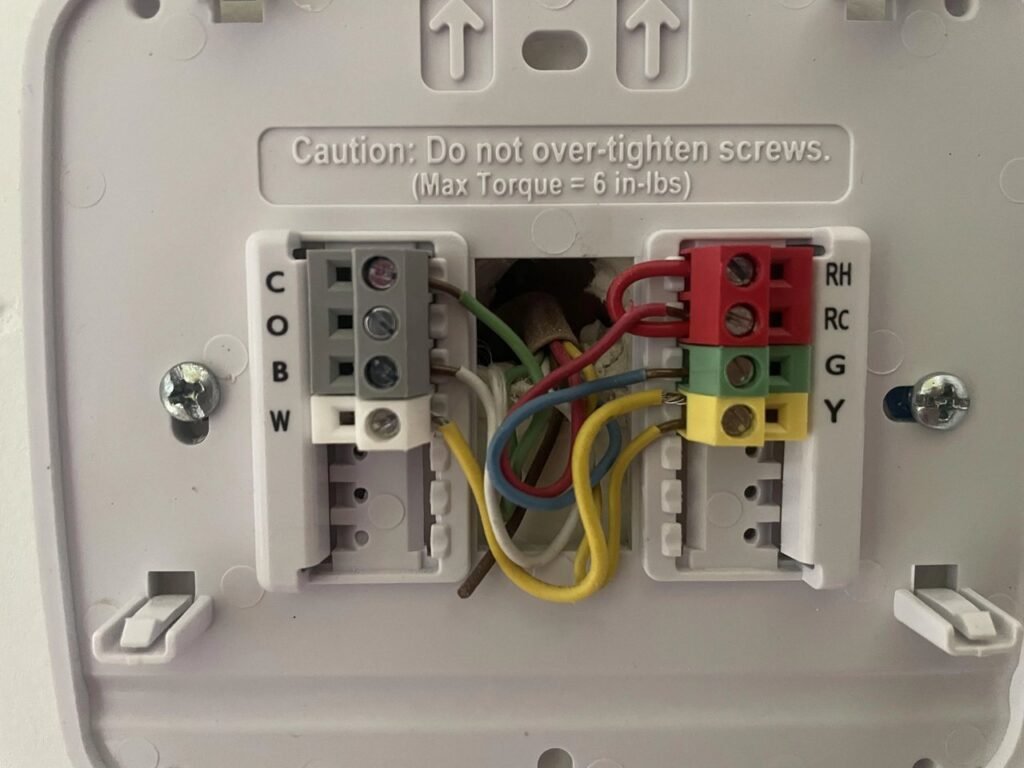
The “Golden Rule” of HVAC Thermostat Wiring Color Code
If there is only one thing you remember from this guide, let it be this: Colors are a suggestion; terminals are the law.
The standard hvac thermostat wiring color code is a best practice. But if the guy who installed the system 15 years ago ran out of 18/5 wire and used telephone wire, or decided to use the Green wire for Heating because the White wire broke inside the wall, you cannot trust the colors.
The Golden Rule: Always trace the wire back to the indoor unit’s control board. If the Yellow wire is hooked up to the “W” terminal on the furnace board, then Yellow is your heating wire, regardless of what the standard hvac color code wiring chart says.
Never blindly hook up a thermostat by matching colors. Always match terminals to terminals (e.g., Y on the stat to Y on the board).
🛠️ Don’t Get Fooled by Bad Wiring
Troubleshooting control boards is a massive part of the NATE exam. Practice tracing circuits with our interactive questions.
Common DIY Disasters and Troubleshooting
As an HVAC professional, you will get dispatched to hundreds of “No Heat / No Cool” calls that were actually caused by a homeowner trying to install a smart thermostat they bought online.
According to Energy.gov, smart thermostats save homeowners money, but the installation process is where they usually mess up. Here are the two most common disasters you will find.
1. Blown 3-Amp Fuses (The “Live Wire” Mistake)
A homeowner decides to swap their thermostat without turning off the breaker to the furnace. While pulling the wires off the old stat, the Red wire (24V Power) touches the Blue/Black wire (Common ground).
Pop. They just shorted the 24V circuit. This instantly blows the 3-amp or 5-amp automotive blade fuse located on the furnace control board. When you arrive, the thermostat will be completely dead.
Fix: Turn off power, properly secure the hvac color code wiring, and replace the fuse on the board.
2. The Missing “C” Wire Problem
Old battery-operated thermostats didn’t need a Common (C) wire because they used AA batteries for power. Modern Wi-Fi thermostats (like Nest or Ecobee) have bright screens and constantly connect to routers—they need dedicated 24V power.
When homeowners discover they only have a 4-wire bundle (R, W, Y, G) in the wall, they get confused.
Fix: As a technician, you have a few options. You can run a brand new 18/5 wire down the wall (the best method). Alternatively, you can use an “Add-a-Wire” adapter diode, or re-purpose the Green (Fan) wire to act as the C-wire, bridging G to Y at the board so the fan still comes on during cooling calls.
How This Applies to Your Certification Exams
If you are preparing for your Journeyman License or NATE certification, you will not be asked simply “What color is the heating wire?” That is too easy.
Instead, you will be given a scenario.
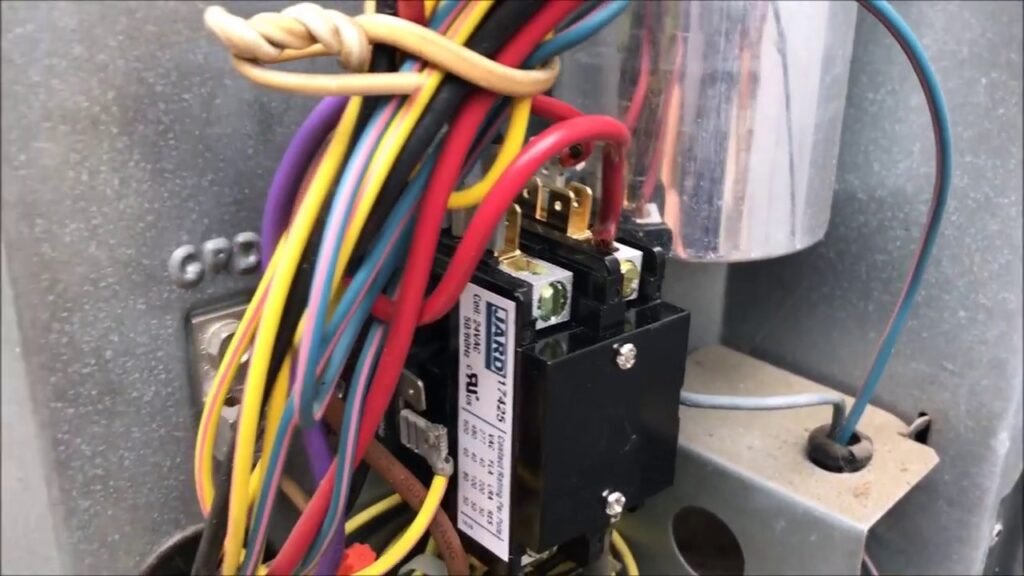
For example: “A technician jumps the R terminal to the Y terminal at the thermostat subbase. What should happen?”
The answer: The compressor contactor and the outdoor fan should energize.
Understanding the flow of electricity through standard hvac color code wiring is the key to passing the most difficult sections of the exam. You have to visualize the electricity leaving the transformer, going through the thermostat, and returning to the load.
Conclusion: Master the Wires, Master the Trade
Whether you are a green helper or a seasoned service technician, low-voltage wiring is something you interact with every single day. By memorizing the standard hvac thermostat wiring color code and understanding the sequence of operations, you can diagnose 80% of residential service calls with just a multimeter and a piece of jumper wire.
Don’t let electrical theory intimidate you. It is entirely logical, and with repetition, it becomes second nature.
Ready to stop guessing and start diagnosing?
Test your electrical troubleshooting skills with our simulation app. We use real-world schematics and scenarios to train your brain before you take your state exams.
📱 Turn Downtime Into Study Time
Access 1,000+ updated questions for EPA, NATE, and Journeyman exams directly in your browser. Master the circuits today.



0 Comments