The Texas Heat: Why You Need to Start Now
If you are looking for top-tier hvac training san antonio texas, Austin, or Dallas, you are already making the smartest career move of 2026.
In Texas, air conditioning is not a luxury; it is a matter of survival. When the summer temperatures hit 105°F for weeks on end, HVAC technicians become the most important people in the state. Because of this extreme demand, Texas offers some of the highest year-round earning potentials in the country. However, you cannot just grab a wrench and start charging people to fix their condensers.
The state has strict rules governed by the Texas Department of Licensing and Regulation (TDLR). If you want to touch a sealed system or pull a permit in the Lone Star State, you have to play by their rules.
In this comprehensive guide, we will break down the exact steps to go from a green helper to a fully licensed Texas HVAC Contractor, what exams you need to pass, and how to get started today.
📊 Test Your Texas Code Knowledge
Do you know the difference between an Environmental Air Conditioning and a Commercial Refrigeration endorsement? Take our diagnostic quiz.
Step 1: Becoming a Registered vs. Certified Technician
Before you even think about running your own HVAC business, you have to get into the system. Texas has a tiered structure for technicians working under a licensed contractor.
The Registered HVAC Technician
This is the entry-level starting point. You must be at least 18 years old. To become a Registered Technician, you simply submit an application to the TDLR, pass a criminal background check, and pay a $20 fee.
- The Catch: You do not need to take an exam for this, but you must work under the direct supervision of a licensed Air Conditioning and Refrigeration (ACR) contractor. You are essentially an apprentice.
The Certified HVAC Technician
This is a step up. A Certified Technician is recognized by the state as having verified hands-on experience or education. To get this, you must complete an approved certification program or have at least 24 months of supervised experience.
- The Benefit: Certified techs command a higher starting salary because contractors know they require less hand-holding.
Step 2: The Federal Hurdle (EPA 608)
Here is a trap many new Texas technicians fall into. You might be registered with the TDLR, but if you don’t have your federal EPA 608 card, you are legally useless on a service call.
According to Federal EPA law, any person who attaches hoses or manifold gauges to an appliance to measure pressure, or who adds/recovers refrigerant, must be certified.
Whether you are attending a local community college or pursuing hvac training san antonio texas, your primary goal in your first month should be passing the EPA 608 Universal exam. The Texas heat means constant compressor swap-outs and leak repairs; if you can’t handle refrigerants, you can’t work.
Resource: Use our free HVAC practice test questions to study the mandatory EPA leak rate percentages before you pay the proctor fee.
Step 3: Evaluating HVAC Training Options in Texas
You have to learn the trade before you can take the contractor exam. Because the state requires 48 months (4 years) of practical experience to get an independent license, many look to trade schools to fast-track their knowledge.
When researching hvac training san antonio texas, Houston, or Dallas, you will find two main routes:
1. Traditional Trade Schools and Community Colleges
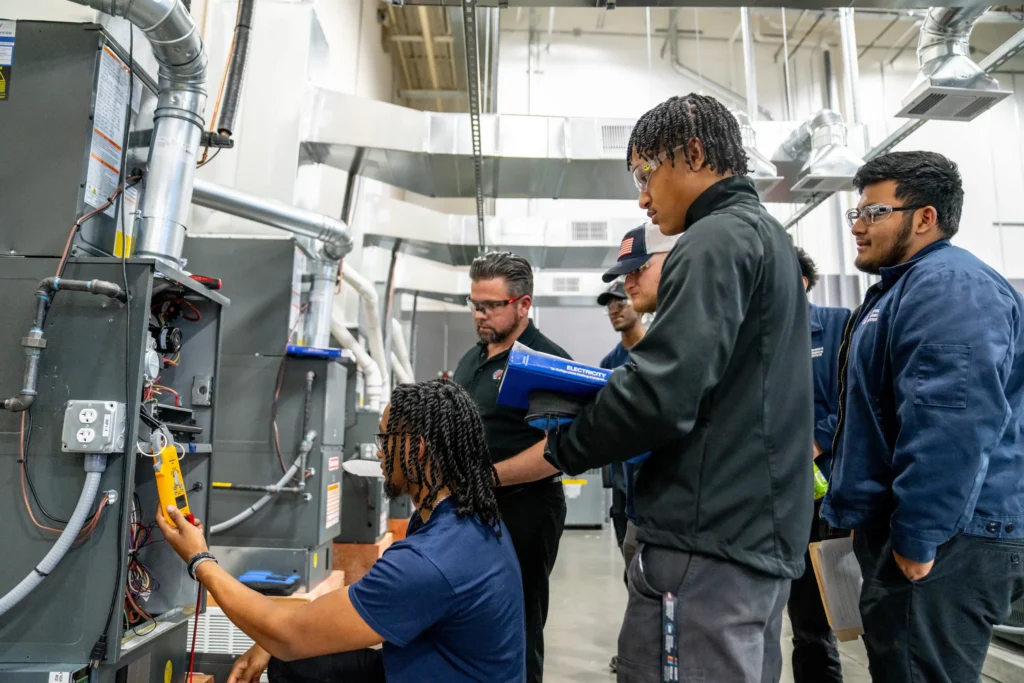
Texas boasts some of the best vocational training in the country. A typical program takes 6 to 12 months.
- Pros: You get hands-on lab time learning to braze copper, wire transformers, and bend sheet metal.
- Cons: Tuition can be expensive, ranging from $5,000 to $15,000.
2. On-the-Job Training (Apprenticeships)
Many students looking for hvac training san antonio texas realize that getting hired as a Registered Technician “helper” is the most cost-effective route. You get paid to carry tools, wash coils, and observe the senior techs.
- The Problem: The lead tech doesn’t have time to teach you the physics of subcooling or electrical theory. You must supplement your fieldwork with intense self-study using exam simulators.
Step 4: The Texas ACR Contractor License
After 48 months of practical experience under a licensed master (or a mix of approved schooling and experience), you are finally eligible to become a “Boss.”
The Texas Air Conditioning and Refrigeration (ACR) Contractor License is divided into Classes and Endorsements.
Class A vs. Class B
- Class A: The big leagues. You can work on any size unit, including massive commercial chillers and industrial process refrigeration.
- Class B: The residential king. You are restricted to cooling systems of 25 tons or less, and heating systems of 1.5 million BTUs or less. (This covers 99% of residential homes and light commercial shops).
Endorsements
You must also choose an endorsement:
- Environmental Air Conditioning: Heating, cooling, and ventilation.
- Commercial Refrigeration: Walk-in coolers, supermarket rack systems, and ice machines.
- (Note: You can hold both endorsements if you pass both sections of the exam).
🛠️ Master the Technical Concepts
To pass the Texas Contractor Exam, you must know advanced electrical troubleshooting and system sizing. Try our advanced simulator.
Passing the Texas State HVAC Exam
The Texas ACR Contractor exam is administered by PSI. It is an open-book test, but do not let that fool you. You cannot walk in and expect to casually look up the answers.
The exam tests you heavily on the Uniform Mechanical Code (UMC) or the International Mechanical Code (IMC), depending on your choice, plus the National Electrical Code (NEC) and Texas-specific administrative rules.
How to Prepare:
- Tab Your Books: You must buy the physical code books and use approved permanent tabs. Knowing exactly where the “Venting” or “Duct Sizing” chapters are will save you critical minutes.
- Practice Navigation: The test is a race against the clock. You need to read a scenario, identify the keyword, and flip to the exact code paragraph in under 60 seconds.
- Simulate the Pressure: Reading a PDF won’t help. You need an exam simulator that forces you to answer questions under a strict timer.
Conclusion: Start Your Texas Journey Today
Texas is arguably the most profitable state for a skilled technician. Whether you pursue formal hvac training san antonio texas or learn on the job in Houston, the path is clear: get registered, get your EPA card, log your hours, and pass the contractor exam.
Don’t wait until year four to start studying. The technicians who pass on their first try are the ones who review electrical theory, thermodynamics, and mechanical codes every single day.
Ready to start your Texas HVAC career?
Don’t risk failing your EPA or State exams. Practice with the most realistic simulation tool on the market.
📱 Ace Your HVAC Exams
Access 1,000+ updated questions for the EPA 608 and Contractor exams directly in your browser. No downloads required.



0 Comments