EPA 608 certification is a federal credential required under Section 608 of the Clean Air Act. Any technician who maintains, services, repairs, or disposes of equipment that could release refrigerant must hold it. There are four types — Type I, Type II, Type III and Universal — and every one of them requires passing the Core section first. The certification does not expire.
What Is EPA 608 Certification?
EPA 608 certification — formally called Section 608 Technician Certification — is issued under the U.S. Environmental Protection Agency's rules for handling refrigerants. It exists because refrigerants released into the atmosphere damage the ozone layer and contribute to climate change, so federal law restricts who is allowed to touch them.
The important thing to understand is that this is not a professional credential you earn to look good on a résumé. It is a legal requirement. Without it, you cannot legally open a refrigerant circuit, and suppliers cannot legally sell you refrigerant.
That distinction separates EPA 608 from every other HVAC credential. A NATE certification demonstrates that you are good at your job. EPA 608 simply establishes that you are allowed to do it at all. Most technicians earn EPA 608 first, early in their career, and treat NATE as the next step once they want to prove technical depth.
One point of confusion worth clearing up immediately: Section 608 covers stationary refrigeration and air conditioning equipment. If you work on car and truck air conditioning, you need Section 609 certification instead — a different exam with different rules.
Who Needs EPA 608 Certification?
The rule is broader than most people assume. You need EPA 608 certification if you maintain, service, repair, or dispose of appliances that contain regulated refrigerants — which in practice covers nearly everyone working hands-on in HVAC/R:
- Residential and commercial HVAC technicians who charge, recover, or evacuate refrigerant.
- Refrigeration technicians working on supermarket racks, walk-in coolers, or ice machines.
- Appliance repair technicians servicing sealed systems in refrigerators, freezers, or window units.
- Apprentices — an apprentice may work without certification only under the direct supervision of a certified technician.
- Anyone who needs to purchase refrigerant, since regulated refrigerants may only be sold to certified technicians.
You do not need EPA 608 if your work never opens a refrigerant circuit — for example, duct installation, sheet metal fabrication, or thermostat and control work on systems you never break into.
Working without certification is not a minor paperwork issue. The EPA can assess civil penalties per day and per violation, and the amounts are adjusted for inflation each year. Employers carry exposure here too, which is why most shops will not put an uncertified tech on a service truck alone.
Core, Type I, Type II, Type III and Universal
This is where most candidates get confused, so it is worth being precise. There are four certification types, but the Core section is not one of them — Core is a mandatory foundation that every candidate must pass regardless of which type they want.
The structure works like this: Core + one type section = that type of certification. Pass Core plus all three type sections and you earn Universal.
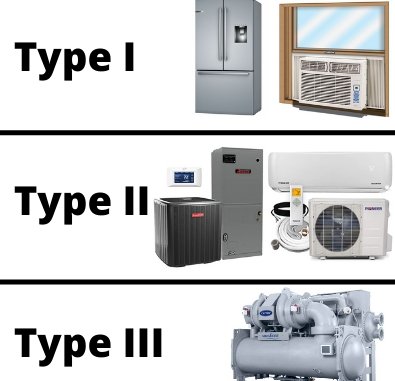 Type I covers small sealed appliances, Type II covers high-pressure
systems, Type III covers low-pressure chillers.
Type I covers small sealed appliances, Type II covers high-pressure
systems, Type III covers low-pressure chillers.
Core (Required for Everyone)
Covers the knowledge that applies to all refrigerant work: ozone depletion and the Clean Air Act, the three R's (recover, recycle, reclaim), refrigerant recovery techniques, safety, shipping, and record keeping. You must pass Core before any type certification is issued.
Practice Core QuestionsType I — Small Appliances
Covers factory-sealed appliances charged with 5 pounds or less of refrigerant: domestic refrigerators and freezers, window air conditioners, water coolers, vending machines, and dehumidifiers. This is the most accessible type and the only one that can typically be earned without a proctor.
Practice Type I QuestionsType II — High-Pressure Appliances
Covers high-pressure and very high-pressure equipment: residential split systems, heat pumps, packaged units, supermarket refrigeration, and process refrigeration. If you work on standard residential and light commercial HVAC, this is the type your daily work actually falls under.
Practice Type II QuestionsType III — Low-Pressure Appliances
Covers low-pressure equipment, primarily centrifugal chillers used in large commercial and institutional buildings. These systems operate under a vacuum, which introduces failure modes — air and moisture infiltration, purge unit operation — that do not appear on the other exams.
Practice Type III QuestionsUniversal — All Three Types
Earned by passing Core plus Type I, Type II and Type III. A Universal card places no restriction on the equipment you can legally service, which is why most employers prefer it and why many technicians go straight for it on the first attempt.
Core + Type I + Type II + Type IIIHow to Choose the Right Certification Type
Match the certification to the equipment you will actually open — and then consider whether the restriction is worth keeping.
| If your work is mostly… | You need at least… |
|---|---|
| Refrigerators, window units, sealed small appliances | Core + Type I |
| Residential split systems, heat pumps, rooftop units | Core + Type II |
| Centrifugal chillers in large buildings | Core + Type III |
| A mix, or you are not sure yet | Universal |
In practice, the last row applies to most people reading this. Early-career technicians rarely know which equipment they will be assigned in two years, and a single-type card becomes a liability the first time a job requires something outside its scope. Upgrading later means registering, paying, and sitting for another exam.
Once you know which sections you need, the EPA 608 study guide breaks down the topics each section tests.
Is EPA 608 Universal Certification Worth It?
For most technicians, yes — and the reason is economic rather than technical.
Many approved testing organizations charge a single exam fee that covers the whole sitting, whether you attempt one type section or all three. If that is true of the provider you choose, attempting Universal costs you additional study time but little or no additional money. Failing a type section on a Universal attempt does not void the rest either: you still receive certification for Core plus whichever type sections you passed.
That asymmetry is what makes Universal the default recommendation. The downside is bounded — you keep what you pass — while the upside is a card with no equipment restrictions.
The realistic argument against it is preparation load. Universal means four sections of material instead of two, and Type III in particular covers low-pressure behavior that a residential tech never encounters on the job. If you are testing next week and have not studied, a focused Core + Type II attempt is the safer plan.
Confirm the fee structure with your testing organization before you decide, since pricing varies. Our HVAC certification cost guide compares what different providers charge.
Does EPA 608 Certification Expire?
No. EPA 608 technician certification does not expire. There is no renewal cycle, no continuing education requirement, and no recertification exam. Once you pass, the certification is valid for the rest of your career.
This surprises technicians who are used to credentials that lapse, and it is one of the clearest differences between EPA 608 and other HVAC certifications:
| Credential | Validity |
|---|---|
| EPA 608 | Does not expire — no renewal required |
| NATE (Professional) | 2 years, renewed with 16 continuing education hours |
The practical catch is your physical card. Employers and refrigerant suppliers will ask for proof of certification, and replacing a lost card means contacting the organization that originally certified you — which is a problem if that organization no longer exists. Photograph your card the day you receive it and keep a digital copy.
If you are weighing what to earn next, see the NATE certification guide for how a renewable professional credential compares.
EPA 608 Exam Format and Passing Score
The exam is section-based, and each section is scored independently. That structure is the single most important thing to understand before you schedule a test date.
- Questions per section: 25 multiple-choice questions in Core and in each type section.
- Universal attempt: 100 questions total (Core + Type I + Type II + Type III).
- Passing score: generally 70 percent, which works out to 18 of 25 correct in each section.
- Scored separately: a strong Core score cannot rescue a weak type section. You must clear the threshold in each section on its own.
- Retakes: you normally retake only the sections you failed, not the entire exam.
Because scoring is per section, the most common failure pattern is uneven preparation — a candidate who knows recovery procedures cold but never studied low-pressure purge units. Passing requires spreading your study time across every section you intend to attempt.
Question counts, time limits, and retake policies vary slightly between approved certifying organizations, so confirm the specifics with yours before test day.
To see the question style and check where you actually stand, work through the free EPA 608 practice test, which is organized by the same Core and Type sections as the real exam.
Know Which Sections You Need? Find Out If You Would Pass.
Understanding the certification is step one. Step two is finding out which sections you are weak in — while it still costs you nothing to be wrong.
- Practice by Core, Type I, Type II or Type III
- Explanations on every question, not just a score
Can You Get EPA 608 Certified Online?
Partly — and the answer depends entirely on which type you are after. This is the area where misleading offers are most common, so it is worth reading carefully.
Type I: yes, usually without a proctor
Type I certification can generally be earned through an approved mail-in or online program, which is why so many "get certified from home" offers exist. These programs are legitimate when the organization behind them is EPA-approved.
Type II, Type III and Universal: proctor required
These exams must be administered under proctor supervision. That does not mean you have to drive to a test center, though — many approved organizations now offer remote online proctoring, where you test from home with a webcam, a locked-down browser, and a live proctor monitoring the session. You are testing online; you are simply not testing unsupervised.
Any offer promising Universal certification with no proctor at all should be treated as a red flag. A certification issued outside the EPA-approved process will not hold up when an employer or refrigerant supplier verifies it.
Two things to verify before paying anyone: that the organization appears on the EPA's list of approved certifying programs, and what the fee actually includes — some advertised prices cover the study material only, with the exam billed separately.
For a closer look at what the free and low-cost online offers really include, see our guide to EPA Universal certification online. For the full registration walkthrough, see how to get EPA 608 certified.
EPA 608 Certification Cost and Where to Take the Test
Exam fees are set by the individual certifying organizations rather than by the EPA, so they vary. Most technicians should budget somewhere in the range of a few tens of dollars for a mail-in Type I program up to roughly $150 for a proctored Universal attempt that includes study material. Retake policies and fees differ by provider as well.
Testing is delivered through EPA-approved certifying organizations, which includes trade schools, union training centers, HVAC distributors, and online proctoring providers. Many supply houses run periodic testing sessions that are cheaper than a standalone exam appointment.
Both topics have their own detailed pages:
- For a full fee breakdown and comparison against other HVAC credentials, see the cost of HVAC certification guide.
- For approved organizations, testing formats, and how to find a session near you, see where to take the EPA 608 test.
Frequently Asked Questions
What is EPA 608 certification?
EPA 608 certification is a federal credential required under Section 608 of the Clean Air Act. Any technician who maintains, services, repairs, or disposes of equipment that could release refrigerant must hold it. It is a legal requirement, not a voluntary professional credential.
What are the four types of EPA 608 certification?
Type I covers small appliances, Type II covers high-pressure and very high-pressure appliances, Type III covers low-pressure appliances such as centrifugal chillers, and Universal covers all three. Every type also requires passing the Core section.
Does EPA 608 certification expire?
No. EPA 608 technician certification does not expire and requires no renewal or continuing education. Once you pass, it is valid for life — unlike NATE certification, which runs on a 2-year cycle.
Can you get EPA 608 certified online?
Type I certification can often be earned through an approved mail-in or online program. Type II, Type III and Universal must be proctored, though many approved organizations offer remote online proctoring so you can test from home with a webcam.
What is a passing score on the EPA 608 exam?
Generally 70 percent, scored separately for each section. With 25 questions per section, that usually means at least 18 correct answers. Passing Core plus one type section earns you that type of certification.
Should I get Universal certification or a single type?
Universal requires passing Core plus all three type sections, but at many providers it costs the same as a single-type exam and removes any restriction on the equipment you can service. Most HVAC technicians are better served going straight for Universal.
Is EPA 608 the same as EPA 609?
No. EPA 608 covers stationary refrigeration and air conditioning equipment. EPA 609 covers motor vehicle air conditioning. If you service car and truck A/C, you need Section 609 instead of, or in addition to, EPA 608.
Do I need EPA 608 certification to buy refrigerant?
Yes. Refrigerants covered under Section 608 may only be sold to certified technicians, so suppliers will ask for proof of certification before selling to you.
You Understand the Certification. Now Find Out If You Would Pass.
Take a free practice test organized by Core, Type I, Type II and Type III — the same structure as the real exam — and see which sections still need work.
Take the EPA 608 Practice Test