How to Become an HVAC Tech in 2026: The Complete Step-by-Step Guide

Starting Your Career: How to Become an HVAC Tech
Are you tired of dead-end jobs and looking for a concrete, step-by-step plan on how to become an hvac tech in 2026? You are making a brilliant decision for your future.
The heating, ventilation, and air conditioning industry is essentially recession-proof. No matter what the stock market is doing, people will always pay money to keep their homes cool in the summer and their pipes from freezing in the winter.
However, entering the skilled trades can feel overwhelming.
If you search the internet, you will be bombarded by advertisements from expensive trade schools telling you that a $20,000 degree is the only way in. That is simply not true.
There is a highly efficient, strategic roadmap to entering this industry without drowning in student debt. In this complete guide, we will break down the exact four steps you need to take to go from a total beginner to a highly paid, fully licensed professional.
📊 Do You Have the Right Mindset?
This trade requires strong mechanical logic and electrical safety awareness. Take a quick diagnostic quiz to see if you are a natural fit.
Step 1: Pass the Mandatory EPA 608 Exam
This is the ultimate “cheat code” that most beginners do not know about.
When figuring out how to become an hvac tech, people usually think they have to go to school first. But the absolute first step you should take is getting your federal certification.
Under the Clean Air Act, it is illegal for anyone to handle, recover, or buy regulated refrigerants without an EPA 608 Certification.
You do not need to attend a 2-year college to take this test. You can self-study the federal regulations, the leak rate thresholds, and the recovery safety protocols at home.
If you pass the Universal EPA 608 exam on your own, you instantly prove to potential employers that you are a highly motivated self-starter. Walking into an interview with your EPA card already in your pocket puts you far ahead of the competition.
Need help getting started? Read our complete EPA 608 Certification Guide to learn what is on the test.
Step 2: Choose Between Trade School and an Apprenticeship
Once you are legally cleared to handle refrigerants, you need to actually learn the physical trade. You cannot learn how to braze a copper pipe or wire a 240V contactor just by reading a book.
You have two main paths to gain this experience.
Option A: Trade School
Enrolling in a local vocational school is the fastest way to get a structured education.
- The Pros: You learn the fundamentals of thermodynamics and electrical troubleshooting in a safe, controlled lab environment.
- The Cons: It costs money. Tuition can range from a few thousand dollars at a community college to over $15,000 at a private institute.
Option B: The Apprenticeship (On-the-Job Training)
If you want to know how to become an hvac tech without taking on debt, an apprenticeship is the answer.
- The Pros: You “earn while you learn.” You get hired as a green helper, carry tools, wash coils, and learn directly from a senior technician. Union apprenticeships also offer excellent benefits.
- The Cons: It is physically brutal, and finding a company willing to train someone with zero experience can be difficult (which is why Step 1 is so important).
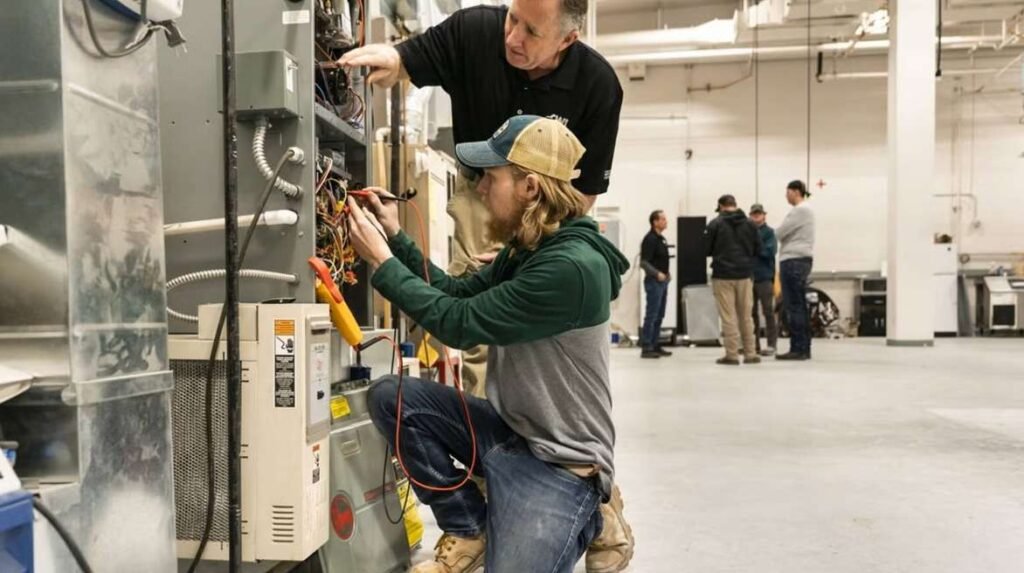
Step 3: Land Your First Job as a Helper
Let’s assume you opted for the apprenticeship route, or you just graduated from trade school. Your next step is entering the field.
Your first job will not be glamorous. You will be a Helper or a Junior Installer.
Your daily tasks will involve crawling through 130-degree attics, carrying heavy condensing units, and fetching tools for the lead technician. You must have a thick skin and a willingness to learn.
According to the Bureau of Labor Statistics (BLS), entry-level mechanics typically start around $18 to $22 per hour. However, your HVAC salary will scale rapidly as soon as you can run your own service van and diagnose problems independently.
🛠️ Transition to Service Faster
Helpers carry heavy tools; Service Techs use their brains. Master the electrical and refrigeration logic quickly with our interactive simulator.
Step 4: Earn Your NATE Certification
Once you have spent 12 to 18 months in the field, you will realize that the guys making the most money are not just hard workers—they are diagnostic experts.
The fastest way to prove you are a master diagnostician is to earn your NATE Certification.
Unlike the EPA exam, which tests legal regulations, NATE (North American Technician Excellence) tests your real-world troubleshooting logic. The exam will throw complex scenarios at you regarding subcooling, superheat, and airflow.
Contractors love NATE-certified technicians because they rarely misdiagnose a system, which severely reduces expensive “callbacks.” Earning this badge is your quickest path to a significant pay raise.
Step 5: Get Your State Journeyman License
The final boss of your career progression is the state license.
To legally work independently without a master technician looking over your shoulder, most states require you to pass a Journeyman exam.
This usually requires logging around 4 to 5 years (8,000 hours) of verifiable field experience. Once you hit that milestone, you must pass a grueling open-book exam based on the International Mechanical Code (IMC) and the National Electrical Code (NEC).
You will be tested on your ability to correctly size ductwork, calculate gas pipe ventilation, and understand safety clearances.
Resource: Want to know what the state board expects? Read our full Journeyman License Guide.
Conclusion: Start Your Journey Today
You now possess the entire blueprint. If someone asks you how to become an hvac tech, you know that it is not just about signing up for a random class.
It is a strategic progression: Pass your federal EPA exam, gain hands-on experience, earn your NATE badge, and conquer your state licensing codes.
The industry is hungry for professionals who are willing to put in the mental and physical work. If you follow these steps, you will secure a lucrative career that robots and artificial intelligence can never replace.
Ready to take that very first step?
Don’t wait to get into a classroom to start learning. You can begin mastering the mandatory EPA 608 regulations right now from your smartphone.
📱 Ace Your Federal Exam First
Get your EPA Universal card before you even apply for a job. Access 1,500+ updated questions directly in your browser.

0 Comments