What is HVAC Certification? The Beginner’s Guide to Licenses in 2026
Certification and Licenses
Are you looking for a straightforward answer about how to get your air conditioning certification and start your new career? You are in the right place.
When you first decide to enter the heating and cooling trade, the sheer number of acronyms can be overwhelming. You hear about trade schools, the EPA, NATE, ICE, and state boards. You ask yourself, what is hvac certification, and do I actually need one to get hired?
The confusion usually comes from how the industry uses three words interchangeably: Certificate, Certification, and License. They sound the same, but they mean entirely different things to an employer and to the federal government.
In this comprehensive 2026 beginner’s guide, we will cut through the noise. We will act as your industry dictionary, explaining exactly what each credential means, which ones are legally mandatory, and which ones will simply make you more money.
📊 Test Your Baseline Knowledge
Before you worry about which exam to take, find out if you know the basics. Take a quick diagnostic quiz to see your current skill level.
The Big Question: What is HVAC Certification?
To put it simply, an HVAC certification is a formal document proving that you have passed a standardized test and possess the knowledge required to safely work on heating, ventilation, and air conditioning equipment.
However, you must understand the “Hierarchy of Credentials.” Let’s break down the three distinct levels every technician navigates during their career.
1. The “Certificate” (Education)
When you graduate from a 6-month trade school or a 2-year community college, you receive a Certificate of Completion or an Associate Degree.
- What it means: It proves you paid tuition and passed your classes.
- The Reality: It does not give you the legal right to handle refrigerants. It is an educational milestone, not a legal working document.
2. The “Certification” (Skills & Law)
This is what most people mean when they search for air conditioning certification. Certifications are granted by third-party organizations (like the federal government or industry groups) after you pass a highly specific, proctored exam.
- What it means: It proves you have mastered a specific safety protocol (like the EPA 608) or a technical skill (like NATE).
- The Reality: Certain certifications are legally mandatory to touch an AC unit.
3. The “License” (The Legal Boss)
A license is issued by your state or local government (like the Texas Department of Licensing and Regulation).
- What it means: It proves you have thousands of hours of field experience and have passed a strict code compliance exam.
- The Reality: A Journeyman License allows you to work without supervision. A Contractor License allows you to pull permits and open your own business.
The Mandatory Air Conditioning Certification: EPA 608
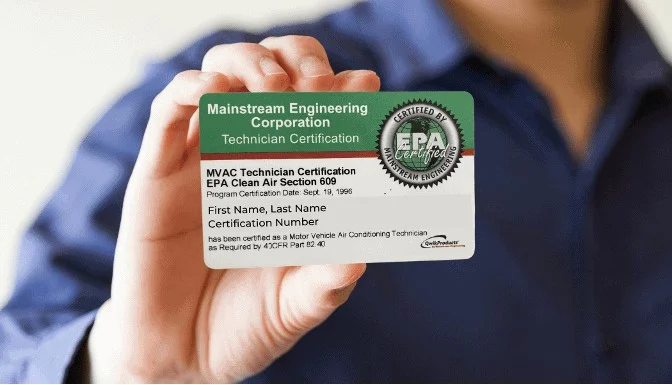
If you only take one thing away from this guide, let it be this: You cannot work in this industry without the EPA 608 Certification.
Under Section 608 of the Clean Air Act, the Environmental Protection Agency (EPA) makes it illegal for anyone to maintain, service, repair, or dispose of appliances that contain regulated refrigerants unless they are certified.
If you are caught hooking up manifold gauges to a condenser without this card in your wallet, you and your employer face massive federal fines.
The EPA 608 exam is broken into four parts:
- Core: Mandatory safety and environmental knowledge.
- Type I: Small appliances (like window units and household fridges).
- Type II: High-pressure appliances (like residential central air and commercial split systems).
- Type III: Low-pressure appliances (like industrial chillers).
If you pass all four sections, you earn the Universal Certification. This is the ultimate goal because it makes you employable by any company in the country.
Resource: Want to know exactly what is on the test? Read our complete EPA 608 Study Guide.
Voluntary Air Conditioning Certification: NATE
So, if the EPA 608 is the only legal requirement, why do you hear so much about other acronyms? Because employers want to hire experts, not just legal minimums.
This brings us to NATE (North American Technician Excellence).
NATE is the largest non-profit certification organization for HVAC technicians in the United States. While not required by federal law, it is the most respected air conditioning certification in the trade.
- Why do it? The EPA exam tests your knowledge of environmental laws. The NATE exam tests your ability to actually fix a broken air conditioner. It asks scenario-based questions about subcooling, superheat, and electrical diagrams.
- The Payoff: According to the NATE organization, certified technicians remain in the industry longer and command higher hourly wages. Many top-tier commercial contractors will not hire you for a senior role unless you hold a NATE badge.
🛠️ Don’t Walk Into the Exam Blind
The EPA and NATE exams are famous for trick questions. Practice with real, updated 2026 scenarios before you pay the testing fee.
Do You Need an Air Conditioning Certification to Get Hired?
If you are a complete beginner looking for your very first job as a helper, the answer is: Yes, get your EPA 608 first.
While some companies offer paid training and will put you through the EPA class themselves, showing up to an interview with your EPA Universal card already in hand is the ultimate cheat code. It shows the service manager that you are serious, self-motivated, and legally ready to touch a system on day one.
You do not need a NATE certification or a State Journeyman License to get hired as an apprentice. Those will come later after you have logged thousands of hours of field experience.

Conclusion: Your Roadmap to Becoming Certified
Now that you know exactly what is hvac certification, your path forward is clear.
- Skip the Confusion: Understand that your primary goal right now is not a state license—it is the federal EPA 608 Universal Certification.
- Study Smart: You don’t need a $15,000 trade school to pass the EPA exam. You can self-study the Clean Air Act regulations, leak rate limits, and recovery cylinder color codes.
- Take Practice Exams: Reading the manual is passive learning. To pass, you need to simulate the pressure of the real exam. Use an HVAC practice test tool to drill the hardest questions until you consistently score over 85%.
- Level Up Later: Once you are working in the field and making money, start studying for your NATE specialties and logging hours toward your Journeyman license.
Ready to secure your future in the trades?
Stop searching for answers and start practicing. Our dedicated exam simulator breaks down the exact concepts you need to pass your certifications on the first try.
📱 Turn Downtime Into Study Time
Access 1,500+ updated questions for the EPA 608 and NATE exams directly in your browser. Get certified faster.


0 Comments