The Complete HVAC Trade School Guide: 2026 Regional Breakdown
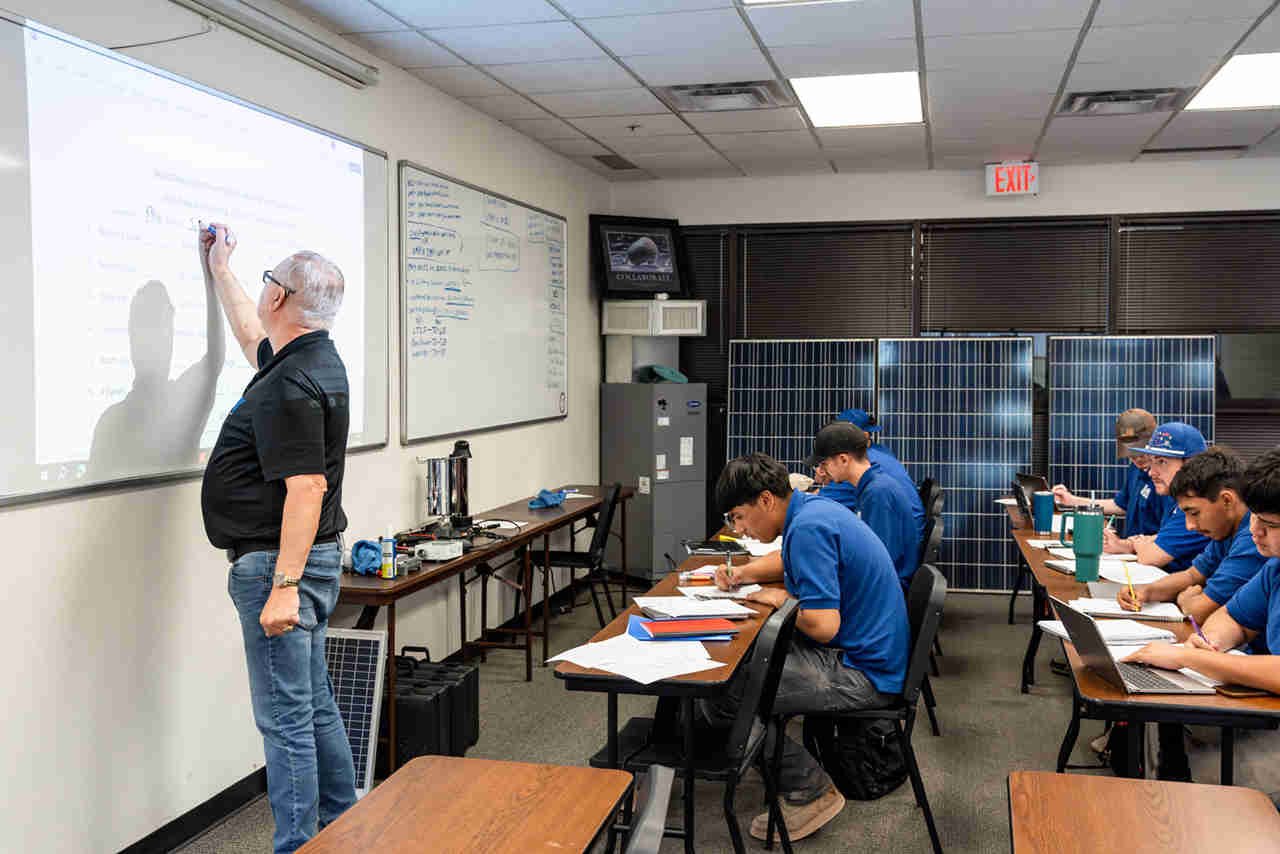
The Fastest Path to a Recession-Proof Career
Are you looking for a reliable hvac trade school to bypass the four-year college trap and start making real money? You are making a highly strategic career move.
The traditional college route often ends with crushing student debt and a degree that doesn’t guarantee a job. The skilled trades are the exact opposite. Heating, ventilation, and air conditioning is a recession-proof industry. Homeowners and commercial businesses will always pay top dollar to keep their properties comfortable and safe.
But entering the trade requires specialized knowledge. You cannot just fake your way through electrical schematics and high-pressure refrigerant cycles. You need formal training.
In this 2026 guide, we will break down exactly how to find legitimate programs, why the city you train in changes what you learn, and how to get a head start on your federal certifications before you even set foot on campus.
📊 Do You Have the Mechanical Mindset?
Before paying tuition, see if you have a natural aptitude for thermodynamics and electrical safety. Take our free diagnostic quiz.
How to Find the Best “HVAC Trade School Near Me”
When you type “hvac trade school near me” into Google, you will be hit with dozens of advertisements. Not all vocational programs are created equal.
Some are highly respected academies that feed directly into commercial unions. Others are “diploma mills” that charge $20,000 for a few online slideshows and outdated lab equipment.
If you are researching trade schools for hvac, you must look for one critical green flag: Industry Accreditation.
A legitimate school will be accredited by a major industry organization, such as HVAC Excellence or PAHRA (Partnership for Air-Conditioning, Heating, Refrigeration Accreditation).
This accreditation means that independent industry experts have audited the school’s live labs, checked their curriculum against 2026 standards, and verified that they actually prepare students for the workforce.
Regional Training: Why Your Location Matters
Here is a reality check that many beginners miss: hvac trade schools do not all teach the exact same thing.
The United States has wildly different climate zones. The equipment a technician repairs in the desert is entirely different from the equipment a technician maintains in the rust belt.
Where you go to school dictates your specialty. Let’s look at three distinct regional examples.
The Desert Heat (The American Southwest)
If you are evaluating trade schools in tucson, Phoenix, or Las Vegas, your entire career will revolve around extreme cooling. In these desert climates, air conditioners run non-stop for nine months out of the year.
Whether you choose technical schools in tucson or other vocational schools in tucson az, the training here must focus heavily on high head-pressure diagnostics and electrical component failure. Because rooftop units bake in 115°F temperatures, capacitors swell and contactors pit constantly.
The Freezing Midwest (The Rust Belt)
Conversely, if you are looking at hvac training chicago, Grand Rapids, or Kansas City, your primary focus flips from cooling to life-saving heating.
In the Midwest, a broken furnace in January causes water pipes to freeze. Chicago is also the stronghold of Pipefitters Local 597, one of the most powerful HVAC unions in the world. Training in this region focuses heavily on combustion analysis, hydronic boilers, and strict carbon monoxide (CO) safety standards required for union-level commercial work.
Tech Hubs & Precision Cooling (Silicon Valley)
What if you want to work in the tech capital of the world? If you are looking at trade schools san jose or the greater San Francisco Bay Area, the curriculum gets highly specialized.
The Bay Area is packed with data centers and massive server farms. These facilities require CRAC (Computer Room Air Conditioning) units that maintain temperature and humidity with extreme precision.
Schools in this region focus heavily on Direct Digital Controls (DDC), building automation systems, and compliance with California’s incredibly strict Title 24 environmental laws.
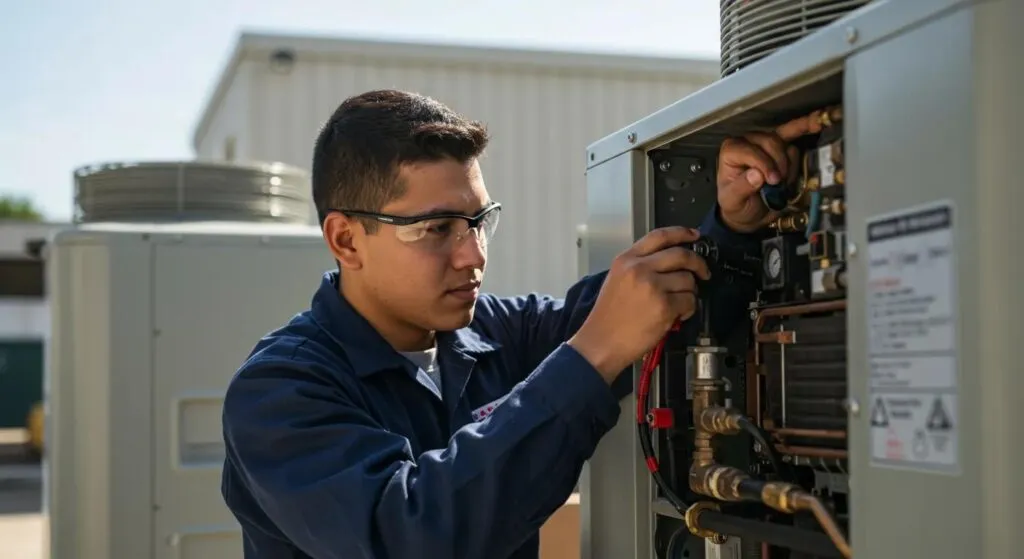
🛠️ The Universal Skill: Electrical Logic
Whether you fix boilers in Michigan or ACs in Arizona, 80% of failures are electrical. Master control boards and schematics in our simulator.
The Ultimate Shortcut: Prep Before You Enroll
Here is the biggest secret to succeeding in an hvac trade school: Do not wait for the instructor to hand you the answers.
Regardless of where you go to school, federal law dictates that you cannot hook up a manifold gauge or handle restricted refrigerants without holding an EPA 608 Certification.
Most schools bundle this exam into their final semester. This is a massive mistake.
If you take the initiative to study the EPA Section 608 rules and pass your Universal exam before your classes even start, you achieve two things:
- You remove the stress of the most critical legal exam from your plate.
- You prove to your instructors (who often have deep ties to local employers) that you are a serious, motivated self-starter.
Resource: Want to know what is actually on the federal exam? Review our complete EPA 608 Certification Prep Guide.
Frequently Asked Questions (FAQ)
Q: How much does an hvac trade school cost?
A: Tuition varies wildly. Community colleges often charge between $4,000 and $8,000, while private, accelerated technical institutes can charge upwards of $20,000. For a complete breakdown, read our >HVAC School Cost & Financial Aid Guide.
Q: How long does it take to finish trade schools for hvac?
A: If you attend a fast-track certificate program, you can graduate in 6 to 10 months. If you pursue an Associate of Applied Science (A.A.S.) degree at a community college, it typically takes two full years (four semesters).
Q: Do I need to go to trade school to get certified?
A: Legally, no. There is no federal requirement that you must attend a formal school to take the EPA 608 exam. You can self-study, pass the exam, and apply directly for an entry-level helper position to learn on the job.
Conclusion: Start Your Journey Today
Choosing the right hvac trade school is a massive stepping stone toward a secure, high-paying career.
Do your homework. Tour the live labs, ask about their job placement rates with local commercial contractors, and ensure their curriculum matches the climate demands of your specific region.
Ready to get a head start on your classmates?
Stop relying on outdated PDF textbooks. Start mastering the mandatory leak rate thresholds, electrical theory, and refrigeration cycles today using the most realistic exam simulator in the industry.
📱 Ace Your Industry Exams
Access 1,500+ updated questions covering the exact topics found on the EPA 608, NATE, and Trade School exams. Guarantee your passing score.


0 Comments