The Best HVAC Training NJ Guide: Navigating the New Jersey Master HVACR License
Launching Your HVAC Career in the Garden State
Are you searching for the best hvac training nj programs to kickstart a high-paying career? You are looking at one of the most lucrative and competitive markets on the East Coast.
New Jersey has a unique climate. Technicians deal with blistering, humid summers and brutal, freezing winters. Because you must master both heavy-duty air conditioning and complex gas heating (or boilers), the skill level required here is much higher than in states with mild weather. Consequently, the HVAC salary potential in NJ is consistently among the top in the nation.
However, working in New Jersey means dealing with strict state laws. You cannot simply open a business and start fixing furnaces. The state requires a highly regulated Master HVACR Contractor license to pull permits and run a company.
In this 2026 guide, we will break down exactly how to get started, what to look for in local trade schools, and the mandatory exams you must pass before you can legally touch a system.
📊 Test Your Baseline Knowledge
New Jersey requires mastery of both heating and cooling. Take a quick diagnostic quiz to see if your mechanical and electrical logic is ready for the trades.
Step 1: The Federal Law You Can’t Skip
Before we even discuss state licenses or local schools, you must pass the federal hurdle. This is the ultimate “cheat code” for getting hired fast.
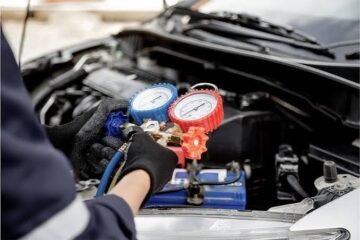
You cannot legally hook up manifold gauges or buy refrigerants without passing the EPA 608 Certification exam. This is mandated by the Environmental Protection Agency (EPA).
When you research hvac training nj options, you will find that most schools include this prep in their final semester. Do not wait that long.
The smartest technicians study the leak rate thresholds and safety codes independently. If you walk into an interview with a New Jersey contractor holding a Universal EPA 608 card, you instantly prove you are employable and ready to ride in a service van on day one.
Finding the Best HVAC Training NJ Offers
If you want to fast-track your path to becoming a licensed contractor, you need formal education. The state of New Jersey allows you to substitute approved classroom hours for a significant portion of your required field experience.
When evaluating an hvac training nj program (whether it is a community college like Lincoln Tech or a local vocational school in Newark or Trenton), look for these green flags:
1. Heavy Focus on Heating and Boilers
In the South, it’s all about AC. In New Jersey, you must be a master of heating. Ensure your school has a massive lab dedicated to gas furnaces, oil burners, and hydronic heating (boilers). If you cannot troubleshoot a flame sensor or calculate combustion air, you will not survive the winter season.
2. Strong Electrical Curriculum
As we emphasized in our Electrical Troubleshooting Guide, 80% of service calls are electrical failures. Your school must teach you how to read complex ladder schematics and use a multimeter effectively.
3. Union Pipeline Connections
New Jersey has a massive union presence (like UA Local 9 or Local 274). Good trade schools have direct relationships with these unions. If you can land a union apprenticeship after graduation, your training will continue for free while you earn a highly competitive wage and pension.
The State Requirement: Master HVACR Contractor License
Unlike some states where you only need a local city permit, New Jersey handles everything at the state level.
To open your own business, bid on jobs, and pull permits, you must obtain the Master HVACR Contractor License. This is strictly governed by the NJ Division of Consumer Affairs.
You cannot just take the test. You must prove you have the experience first.
The Experience Pathways
New Jersey gives you a few different ways to qualify to sit for the exam. The most common routes include:
- The Degree Route: A bachelor’s degree in HVACR plus 1 year of hands-on experience.
- The Trade School Route: A 4-year approved apprenticeship program plus 1 year of experience as a journeyman.
- The Hard Way: 5 years of verifiable, hands-on employment in the HVACR field without formal approved schooling.
Note: This is why choosing an accredited hvac training nj program is so critical. It shaves years off the time it takes to qualify for your master license.
🛠️ Master the Technical Codes
To pass the NJ state exam, you must know advanced mechanical and electrical codes. Practice these exact scenarios now.
Passing the New Jersey State Board Exam
Once the state approves your experience, you must pass the official exam. In New Jersey, this is a two-part test typically administered by PSI Exams.
- Business and Law Exam: You must prove you know how to run a legitimate business. This covers tax laws, workers’ compensation, OSHA safety rules, and estimating.
- The Trade Exam: This is the technical beast. You will be tested on the International Mechanical Code (IMC), the International Fuel Gas Code (IFGC), and the National Electrical Code (NEC).
The “Open Book” Trap
The Trade exam is open-book, but do not let that fool you. You will not have time to casually read the book during the test. You must use approved, permanent tabs on your code books and practice your navigation speed. If you cannot find a gas pipe sizing chart in under 60 seconds, you will run out of time.
For more tips on how to pass open-book state exams, read our comprehensive Journeyman License Guide.
Taking Your Career to the Next Level
After you pass the state exam, you are officially a Master HVACR Contractor. But top-tier technicians never stop learning.
If you want to completely dominate the residential and light-commercial service market in New Jersey, consider adding a NATE Certification to your resume. NATE proves that your diagnostic skills are elite. When customers or employers see that patch, they know you will fix the system right the first time, drastically reducing callbacks.
Conclusion: Build Your Foundation Today
Working in the HVAC trade in New Jersey is physically demanding, but the financial rewards are massive.
Whether you decide to enroll in a formal hvac training nj technical school or fight your way up through a union apprenticeship, your success depends entirely on your grasp of the fundamentals. You cannot fake your way through electrical circuits or refrigerant laws.
Ready to start training your brain?
Don’t wait until the week before your exams to realize you forgot how to calculate superheat. Start drilling the exact concepts you need to pass your federal and state tests today.
📱 Prep Smart, Pass Fast
Access 1,500+ updated questions covering the exact topics found on the EPA 608 and NATE certification exams. Start practicing directly in your browser.

4 Comments
kalapi patel · July 30, 2026 at 11:55 am
i recently moved from Canada, where i was working as HVAC technician and have got journey person license along with 1.5 years of HVAC certification course, i have done bachelor of engineering in Mechatronics, which is 4 years.
I have 9 years of experience as HVAC technician.
i wants to know how do i get my master license in NJ? without doing everything all over again.
Thanks
Dave Thompson · August 10, 2026 at 2:41 am
Hi, your Canadian education and experience may help you qualify without repeating a full apprenticeship, but the New Jersey HVACR Board must evaluate them.
Your four-year Mechatronics Engineering degree may be accepted as a field related to HVACR. Under that pathway, New Jersey generally requires three years of journeyperson-level HVACR experience. Your nine years of experience may satisfy this requirement if you can document it with transcripts, licenses, employer letters, dates, duties, and work-verification records. The Board may also require a foreign credential evaluation.
A Canadian journeyperson license does not automatically transfer through New Jersey reciprocity. You should submit an application with all your education and experience documents and let the Board determine your eligibility. If approved, you will still need to pass the New Jersey Master HVACR licensing examination.
Before enrolling in another apprenticeship, contact the New Jersey HVACR Board at 973-504-6250 and ask how they want your Canadian credentials and experience documented. You may also need a separate EPA Section 608 certification to handle regulated refrigerants in the United States.
Joe Walker · September 8, 2026 at 6:26 am
I live and work in NJ for a company based in Delaware as a HVAC Technician for the past 13 years. I currently hold a master HVAC license in Delaware and graduated From a trade school In Arizona in 2013 earning a associate’s degree in mechanical maintenance engineering which about 10 years ago when applying for NJ master hvac exam excepted and said that I need another 2 years of apprenticeship. My company refused to sign up for apprenticeship and since then been trying to sit for the NJ exam. My company hired in 2019 a NJ master HVAC license holder in which helps with 7 years to date worked under his license and can sign for me that I worked under his license. My question is that since it’s been 10 years since I applied to the NJ HVAC board and was told by Delaware staff that they review applications on a case by case basis.
I currently Do Not Have a Certificate of completion from the dept of labor and wondering if the board would let me sit for the exam with the credentials I hold at this point.
James Miller · September 9, 2026 at 7:08 am
Your seven years working under a New Jersey-licensed Master HVACR contractor should count as strong proof of journeyperson experience. Unfortunately, it probably won’t replace the Department of Labor apprenticeship certificate required for applicants using the two-year degree route.
Your Delaware master license won’t transfer automatically either, since New Jersey does not currently offer HVACR reciprocity with Delaware.
It’s still worth applying again. Include the Board’s previous letter, your school transcript, Delaware license verification, W-2s, and a signed and sealed statement from the NJ Master who supervised you. If the apprenticeship certificate is the only thing missing, ask a registered apprenticeship sponsor whether they can credit your previous education and work experience so you don’t have to start from the beginning.
For a final answer on eligibility, contact the NJ HVACR Board at HVACR@dca.njoag.gov or 973-504-6250.