The Best R448A PT Chart Guide: Commercial Refrigeration & Glide
The High Stakes of Commercial Refrigeration
Are you looking for an accurate r448a pt chart to diagnose a massive commercial freezer or supermarket rack system? You are operating in the most unforgiving sector of the HVACR industry.
In residential air conditioning, a misdiagnosed system means a homeowner sleeps in a warm house for a night. In commercial refrigeration, a misdiagnosed system means a grocery store loses $50,000 worth of frozen meat and ice cream in a matter of hours.
The stakes are incredibly high, and the technology is changing rapidly. The industry standard is shifting, and technicians must adapt their diagnostic methods to survive. In this 2026 technical guide, we will provide you with a reliable pressure-temperature reference for R-448A.
More importantly, we will explain the dangerous concept of “temperature glide” and why you can no longer rely on your old pressure charts to calculate superheat and subcooling.
📊 Test Your Commercial Logic
Commercial refrigeration requires advanced thermodynamic skills. Take a quick diagnostic quiz to see if you can handle high-pressure commercial systems.
Why the 404A P-T Chart is Becoming Obsolete
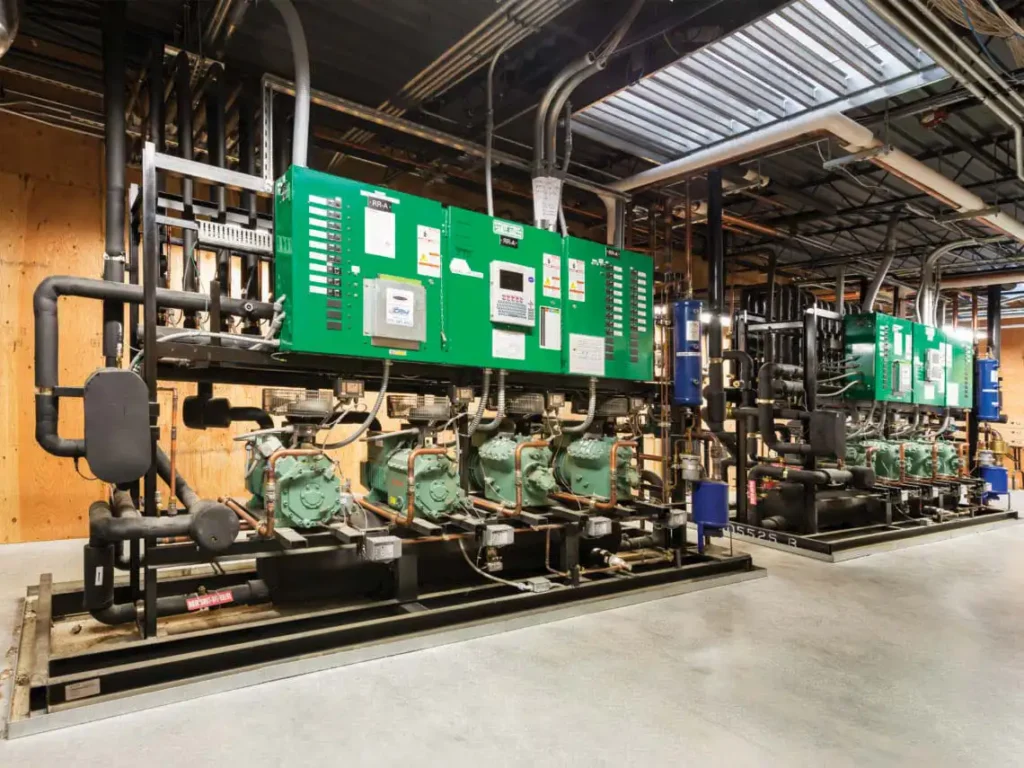
If you have been in the commercial refrigeration game for a while, you probably have a 404a p-t chart memorized in your head. For years, R-404A was the absolute king of low and medium-temperature commercial systems, powering almost every walk-in freezer and supermarket display case.
However, R-404A has a massive Global Warming Potential (GWP) of nearly 3,922. Under strict new federal EPA regulations, the production and import of high-GWP HFCs are being aggressively phased down.
As a result, major chemical manufacturers like Chemours introduced Opteon™ N40 (ASHRAE designation R-448A) as the premier non-flammable, low-GWP drop-in replacement.
If you are performing retrofits or servicing newly installed commercial rack systems, you must put away your old gauges and pull out an updated r448a pt chart.
The Official R-448A Pressure Temperature Chart
Because R-448A is a zeotropic blend (meaning it is a mixture of several different chemicals), it behaves differently than pure refrigerants. You cannot just look at one pressure number.
You must look at a dual-column 448a pt chart that separates the Liquid (Bubble Point) from the Vapor (Dew Point).
(Copy or bookmark this quick-reference chart for your next commercial service call):
| Temp (°F) | Liquid (Bubble) PSIG | Vapor (Dew) PSIG |
| -20° | 13.9 | 8.3 |
| -10° | 21.0 | 14.5 |
| 0° | 29.3 | 21.9 |
| 10° | 38.8 | 30.5 |
| 20° | 49.7 | 40.4 |
| 30° | 62.0 | 51.7 |
| 40° | 76.0 | 64.6 |
| 80° | 154.5 | 136.6 |
| 90° | 180.7 | 161.2 |
| 100° | 209.6 | 188.4 |
The Danger of Temperature Glide
When you look at a standard 448 pt chart, the most obvious difference is the gap between the Liquid and Vapor pressures at the same temperature. This gap is called Temperature Glide.
R-448A has a significant temperature glide of about 6°F to 8°F.
This means that as the refrigerant boils in the evaporator, the temperature of the gas actually increases during the boiling process, even before it turns completely into a vapor.
If you ignore this glide, your diagnostic math will be completely wrong, leading to flooded compressors or starving evaporator coils.
How to Calculate Superheat with Glide
To prevent liquid slugging in your commercial compressors, you must check superheat at the suction line.
- The Rule: Always use the Vapor (Dew) column on your r448a pt chart.
- Find your suction pressure (e.g., 64.6 PSIG). The chart says the saturation temp is 40°F. If your actual pipe temperature is 50°F, your Superheat is 10°F.
How to Calculate Subcooling with Glide
To ensure your Thermostatic Expansion Valves (TXVs) are getting a solid column of liquid, you must check subcooling at the liquid line.
- The Rule: Always use the Liquid (Bubble) column on your r448a pt chart.
- Find your high-side pressure (e.g., 209.6 PSIG). The chart says the saturation temp is 100°F. If your actual liquid line temperature is 90°F, your Subcooling is 10°F.
🛠️ Stop Guessing the Math
Commercial certifications will test your knowledge of temperature glide and mixed refrigerants. Practice these exact calculations in our simulator.
Federal Regulations for Commercial Systems
Working on heavy commercial refrigeration does not just require advanced math skills; it requires strict legal compliance.
Because supermarket rack systems contain hundreds—sometimes thousands—of pounds of refrigerant, the federal government monitors them closely.
If you are working on these systems, you must hold a valid EPA 608 Type II or Universal certification. Furthermore, you must memorize the strict commercial leak repair rules.
For commercial refrigeration systems containing more than 50 pounds of refrigerant, the EPA mandates that any leak exceeding a 20% annual leak rate must be repaired within 30 days.
If you are a commercial technician, you cannot afford to guess these numbers. Failing an EPA inspection can result in tens of thousands of dollars in fines for your contracting company.
Resource: Make sure your federal knowledge is up to date. Review our complete EPA 608 Practice Test Guide before stepping onto a commercial job site.
Conclusion: Elevate Your Commercial Career
Transitioning from residential comfort cooling into the heavy-duty world of commercial refrigeration is the ultimate career upgrade.
However, the equipment is unforgiving. You can no longer rely on simple rules of thumb.
You must understand how to read an r448a pt chart correctly, utilizing both the Bubble and Dew point columns to navigate temperature glide. You must accurately calculate superheat to protect massive, expensive compressors, and you must know the federal laws regarding commercial leak rates inside and out.
Ready to become a master commercial diagnostician?
Don’t wait until you are standing on a freezing supermarket roof at 2:00 AM to realize you don’t understand the refrigeration cycle.
📱 Ace Your Industry Certifications
Access 1,500+ updated questions covering the exact topics found on the EPA 608 and NATE Commercial Refrigeration exams. Start practicing today.

0 Comments