The Honest Guide to the EPA Freon Certification & Refrigerant License
Busting the Biggest Myth in the HVAC Industry
Are you searching the internet trying to figure out how to get an epa freon certification so you can start fixing air conditioners? You are in the right place, but we need to clear up a massive industry misunderstanding first.
If you walk into a professional HVAC wholesale supply house and ask the manager for a “freon license” application, they will probably laugh at you.
Why? Because legally and technically speaking, there is no such thing as a freon certification.
However, we know exactly what you are looking for. You are looking for the federal credential that gives you the legal right to purchase, handle, and recover cooling chemicals without facing massive government fines.
In this honest 2026 guide, we are going to translate the “layman terms” into professional technician terms. We will explain what happened to actual Freon, what the government actually requires you to hold, and how to pass the exam on your first try.
📊 Test Your Refrigerant Knowledge
Do you know the difference between an HFC and an HCFC? Take a quick diagnostic quiz to verify your federal code knowledge before you apply for a license.
The Kleenex Effect: What is Freon, Really?
To understand why the term epa freon certification is technically incorrect, you have to understand branding.
Think about how people use the word “Kleenex.” When someone sneezes, they ask for a Kleenex, even if the box on the table is actually made by Puffs or Scotties. Kleenex is just a highly successful brand name for facial tissue.
The exact same thing happened in the HVAC industry.
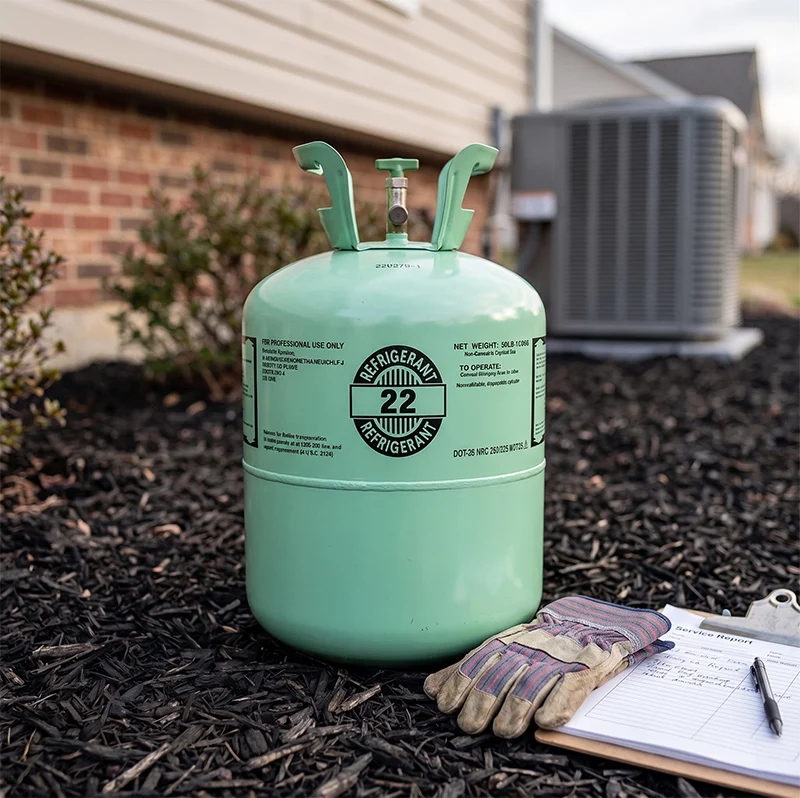
“Freon” is a registered trademark owned by the Chemours Company (formerly DuPont). Decades ago, they used the name Freon for their specific brand of R-12 and R-22 refrigerants. Because those chemicals were used in almost every home and car in America, the public started calling all refrigerants “Freon.”
When someone says they need a freon license, what they are actually saying is they need a refrigerant license.
The Real Name: EPA 608 Certification
Now that we know the proper terminology, let’s talk about the actual legal document you need.
The credential you are looking for is called the EPA 608 Certification.
Under Section 608 of the federal Clean Air Act, the United States government made it strictly illegal to intentionally vent ozone-depleting substances or greenhouse gases into the atmosphere.
To ensure that technicians know how to safely capture and recycle these chemicals, the government created a mandatory test. You must pass this test to earn your official epa refrigerant certification.
Without this card, you cannot buy restricted refrigerants at a supply house, and no reputable HVAC company will allow you to run a service van.
The Four Levels of Certification
When you apply for an epa license for refrigerant, you do not just take one generic test. The credential is broken down into four distinct types based on the equipment you want to work on:
- Type I: For servicing small appliances (like window AC units and vending machines with 5 lbs of refrigerant or less).
- Type II: For servicing high-pressure appliances (like standard residential central air conditioners and supermarket coolers).
- Type III: For servicing low-pressure appliances (like massive industrial chillers).
- Universal: This is the ultimate goal. If you pass all the sections above, you earn Universal status, meaning you can legally work on any stationary HVAC system in the country.
Related Resource: Want to know exactly what is on the test? Read our complete EPA 608 Study Guide.
The Death of Real “Freon” (R-22 Phase-Out)
There is another massive reason why the term epa freon certification is outdated. The actual chemical that made the “Freon” name famous—R-22—is dead.
R-22 is an HCFC (Hydrochlorofluorocarbon). Because it contains chlorine, it is highly destructive to the Earth’s ozone layer. The federal government mandated a complete phase-out of R-22. As of January 1, 2020, it became illegal to manufacture or import virgin R-22 into the United States.
Today, if you find an old system that still runs on R-22, you either have to use incredibly expensive reclaimed R-22, or you have to retrograde the system to use a drop-in replacement (like MO99 / R-438A).
Deep Dive: If you are dealing with an old system, make sure you know how to read the pressures correctly. Check out our MO99 PT Chart Guide.
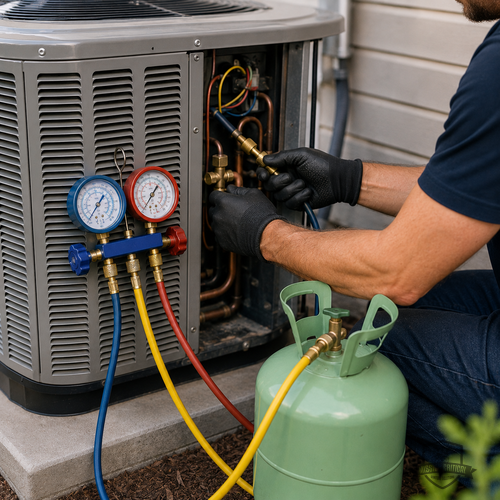
Modern systems use HFCs like Puron (R-410A), and moving into 2026, the industry is shifting to mildly flammable A2L refrigerants like R-454B. You need an epa refrigerant certification to handle all of them.
🛠️ Don’t Fail the EPA Exam
You must memorize specific leak rate thresholds and dates for the phase-out of R-22. Practice these exact scenarios now.
DIY Warning: Can a Homeowner Get a Refrigerant License?
We see a lot of homeowners searching for a freon license because their home AC is blowing warm air, and they want to buy a jug of refrigerant on the internet to top it off themselves to save money.
Here is the brutal truth: You cannot just buy a license.
To get the license, you must pass the proctored exam. The exam is incredibly technical. It requires you to understand deep vacuums, micron gauges, saturation temperatures, and environmental law.
Even if a homeowner manages to pass the exam and get their card, “topping off” a leaking AC is illegal under certain leak-rate thresholds. Furthermore, without a $400 set of manifold gauges, a $300 vacuum pump, and a $500 recovery machine, a homeowner cannot safely or legally handle the chemicals.
If you are a DIYer, it is much cheaper and safer to hire a licensed professional.
If you are looking to actually start a career in the trades, securing this credential is your absolute first priority.
How to Get Your License in 2026
If you are ready to become a professional and earn your epa freon certification (officially the EPA 608), you do not need to attend a two-year college.
You can self-study and pass the exam for less than $150. Here is the smartest way to do it:
- Ditch the Boring PDFs: The EPA study guides are dry, legal documents. Reading them from cover to cover will put you to sleep, and you won’t retain the numbers.
- Use Active Recall: The exam is a multiple-choice test. The best way to study is to use an exam simulator. Forcing your brain to answer questions about recovery vacuum levels builds muscle memory.
- Book an Online Proctor: Once you are consistently scoring 85% on your practice tests, book an exam through an approved online proctor (like Esco or SkillCat). You can take the test from your kitchen table using a webcam.
Conclusion: Start Your Career the Right Way
Now you know the truth. Stop asking employers how to get a freon certification, and start telling them you are actively studying for your EPA 608 Universal credentials. Using the correct terminology proves you belong in the industry.
The HVAC trade is desperate for sharp, knowledgeable technicians. Getting your federal licensing sorted out is the easiest way to jump to the front of the hiring line and secure a high-paying Apprentice job.
Ready to get certified?
Don’t risk your money by taking the exam unprepared. If you fail, you have to pay the proctor fee again. Master the federal regulations and the thermodynamics first.
📱 Ace Your Federal Exam Today
Access 1,500+ updated questions covering the exact topics found on the EPA 608 Universal exam. Stop guessing and start passing.


0 Comments