The Best HVAC App Guide 2026: Top 5 Tools Every Technician Needs
Upgrade Your Toolbag: Why You Need a Digital Assistant
Are you searching for the best hvac app to make your life easier in the field and help you advance your career? You have come to the right place.
Ten years ago, a technician’s most valuable tools were a trusty set of analog manifold gauges, a dog-eared pocket PT chart, and a heavily highlighted code book. Today, relying strictly on paper and analog tools will cost you time, money, and accuracy.
In 2026, modern heating and cooling systems are essentially giant computers. You are dealing with variable-speed inverter boards, communicating thermostats, and complex A2L refrigerant regulations. To diagnose these systems quickly and legally, your smartphone is now just as important as your multimeter.
But the App Store is flooded with garbage apps that crash constantly or have outdated 2018 regulations.
In this comprehensive guide, we are going to cut through the noise. We have ranked the top 5 essential applications every technician needs on their phone—from mastering your licensing exams to calculating live superheat on a commercial rooftop.
📊 Test Your Industry Knowledge
Before downloading any tools, verify your baseline skills. Take our quick diagnostic quiz to see if your electrical and mechanical logic is solid.
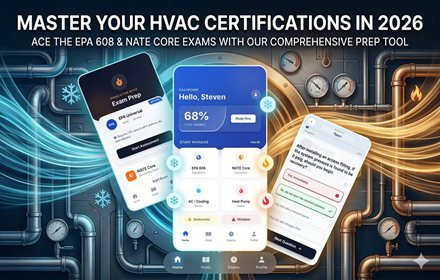
1. HVAC Exam Master (Best for Career Advancement)
Most field apps help you fix an air conditioner. This hvac app helps you fix your paycheck.
Before you can legally touch a manifold gauge or pull a deep vacuum on a system, you must pass rigorous federal and state exams. This is where HVAC Exam Master comes in.
It is universally recognized as the most efficient way to study for the exams that actually boost yourHVAC technician salar.
Why You Need It:
Instead of reading a boring 400-page PDF manual that hasn’t been updated since 2020, this tool uses “Active Recall.” It forces you to interact with scenario-based questions.
- EPA 608 Prep: Memorize the strict 2026 leak rate thresholds and recovery vacuum levels. If you fail the EPA exam, you are legally unemployable.
- NATE Certification: Practice complex electrical troubleshooting and thermodynamic scenarios.
- Journeyman Exams: Drill IMC code lookup questions.
If you are an apprentice or a technician looking to get promoted to a Lead Service role, this is the first tool you should open every morning.
Resource: Want to test it out first? Try our Free Practice Questions Guide.
2. MeasureQuick (Best for Live Diagnostics)
Once you have your licenses and you are in the field, you need a diagnostic powerhouse. MeasureQuick has revolutionized how technicians service equipment.
If you own digital Bluetooth tools (like Fieldpiece or Testo probes), this is the undisputed king of the industry.
Why You Need It:
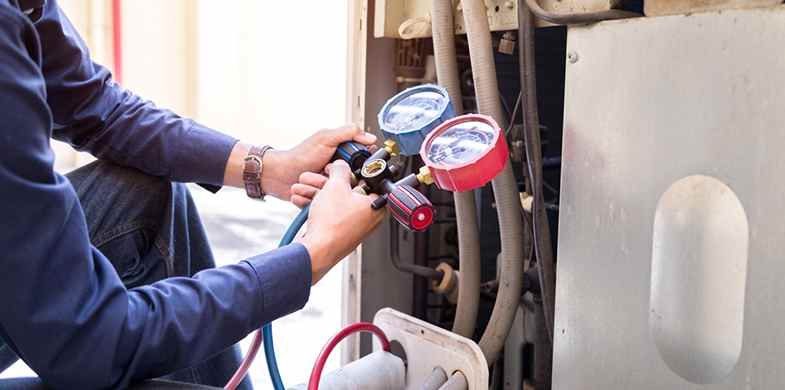
This hvac app connects wirelessly to your gauges, thermometers, and psychrometers. Instead of doing the math in your head, the app pulls in the live data and calculates your superheat, subcooling, and system capacity in real-time.
More importantly, it provides “non-invasive” diagnostics. It will literally flag faults on the screen, telling you if the system has a dirty filter, a failing compressor, or a restricted metering device based on the data stream. It prevents you from being a “parts changer” and turns you into a precise diagnostician.
3. Bluon (Best for Manuals & Parts)
The days of calling technical support and waiting on hold for 45 minutes while standing on a blazing hot roof are over. Bluon is essentially a massive, crowdsourced encyclopedia for HVAC technicians.
Why You Need It:
You will encounter decades-old equipment where the data plate is completely faded.
Bluon’s massive database contains over 300,000 specific HVAC models. You simply type in the model number, and the app instantly provides:
- Original factory manuals and wiring schematics.
- Specific replacement part numbers.
- Guides for retrofitting old R-22 systems with modern drop-in refrigerants.
It also features a live tech support forum where you can ask veteran technicians for advice on weird, unexplainable system behaviors.
4. Danfoss Ref Tools (Best for PT Charts)
Every technician used to carry a cardboard Pressure-Temperature (PT) chart in their shirt pocket. When it got wet or covered in oil, you had to guess the saturation temperatures.
Danfoss Ref Tools (formerly known as the Refrigerant Slider) digitized the pocket chart and made it infinitely better.
Why You Need It:
As the industry phases out HFCs, you are going to encounter dozens of new, mildly flammable A2L refrigerants (like R-454B and R-32) and natural refrigerants (like CO2).
This app provides instant, highly accurate pressure-to-temperature conversions for over 80 different refrigerants. It is a lightweight, blazing-fast reference tool that you will use on every single service call to verify if your system is properly charged.
🛠️ Stop Guessing the Math
Field tools are great, but exams require you to know the formulas. Practice calculating superheat and subcooling manually with our interactive simulator.
5. OSHA Safety/Heat Tool (Best for Survival)
This is the one application that might literally save your life.
Working in the trades means dealing with extreme environmental hazards. The OSHA (Occupational Safety and Health Administration) Heat Safety Tool is a must-have for anyone working in the Sunbelt states or doing commercial rooftop installations.
Why You Need It:
Attics and commercial roofs can easily exceed 130°F. This app calculates the “heat index” for your specific job site.
It provides risk levels and tells you exactly how much water you should be drinking and how often you need to take mandatory rest breaks to prevent heatstroke. It is a critical safety tool that every foreman and lead technician should monitor.
Frequently Asked Questions (FAQ)
Q: Do I really need an hvac app to pass the EPA 608?
A: You cannot bring a phone into the proctored exam room. However, using a dedicated study app before the exam is the most proven way to memorize the mandatory leak rate thresholds and dates required to earn your EPA 608 Universal certification.
Q: Are digital manifold gauges better than analog?
A: Yes. While analog gauges are reliable, digital manifolds sync directly with diagnostic apps (like MeasureQuick) to calculate superheat and subcooling in real-time, completely eliminating mathematical errors on the job site.
Q: What is the best app for reading wiring diagrams?
A: Bluon is highly rated for pulling up factory OEM manuals and schematics. However, to learn how to read those diagrams, you should use our electrical simulator to practice tracing voltage drops and identifying broken circuits.
Conclusion: Work Smarter, Earn More
The skilled trades are evolving. The technicians who refuse to adapt to digital tools will be left behind, fixing outdated equipment for lower wages.
By loading your phone with the right diagnostic software and reference manuals, you eliminate the guesswork. You save time on service calls, reduce costly callbacks, and impress your service managers.
But before you can use the fancy field tools, you have to get licensed.
Ready to secure your future in the industry?
Stop relying on boring PDF manuals to study for your career-defining exams. Use the ultimate digital tool to guarantee your passing score.
📱 Ace Your Exams Today
Access 1,000+ updated questions for the EPA 608, NATE, and State Licensing exams directly in your browser. Start studying instantly.

0 Comments