The Ultimate Guide to Professional Air Quality Testing for HVAC Techs
The Most Profitable Skill You Aren’t Using
Are you looking to maximize your value as a technician? Learning how to offer professional air quality testing is your golden ticket.
If you are a service technician running residential or light commercial calls, your primary job is to fix broken equipment. But what happens during the “shoulder seasons” (spring and fall) when the weather is mild and the heating and cooling systems are running fine?
Your ticket sizes drop, and your commission plummets.
The smartest technicians know that indoor air quality (IAQ) is the key to year-round profitability. Since the pandemic, homeowners are hyper-aware of what they are breathing. According to the Environmental Protection Agency (EPA), indoor air can be two to five times more polluted than outdoor air.
In this 2026 technical guide, we will teach you how to shift from being a “parts-changer” to a trusted IAQ consultant. We will break down how to conduct the tests, what equipment to use, and the underlying physics you must understand to prescribe the right solutions.
📊 Test Your Psychrometrics Knowledge
IAQ requires a deep understanding of humidity and airflow. Take our quick diagnostic quiz to see if your NATE-level physics logic is sharp.
What Does Professional Air Quality Testing Actually Mean?
Many green helpers think that checking the customer’s 1-inch fiberglass air filter is enough. It is not.
True professional indoor air quality testing goes far beyond basic filtration. It is a scientific assessment of the living environment. As an HVAC pro, you are evaluating the air for hidden dangers that affect health and comfort.
When conducting professional air quality testing, you are looking for four main culprits:
- Particulates: Dust, pollen, pet dander, and PM2.5 particles that trigger asthma.
- Biological Contaminants: Mold spores, mildew, and bacteria growing inside wet evaporator coils or leaky ductwork.
- Volatile Organic Compounds (VOCs): Chemical off-gassing from new carpets, paint, and cleaning supplies trapped inside tightly sealed modern homes.
- Humidity Issues: High humidity breeds mold; low humidity damages wood floors and causes respiratory irritation.
To diagnose these issues accurately, you must invest in high-quality professional air quality testing equipment, such as digital hygrometers, particle counters, and VOC monitors.
The Science Behind IAQ: Why Airflow is King
You cannot fix bad air if you do not understand how air moves. This is where the men are separated from the boys in this trade.
If a customer complains about a musty smell, you cannot just slap a UV light in the duct and call it a day. You have to understand why the moisture is trapped there in the first place.
Mastering Psychrometrics
Psychrometrics is the study of moist air. If you want to increase your HVAC technician salary by selling whole-home dehumidifiers, you must know how to calculate sensible heat versus latent heat.
If an air conditioner is oversized, it will cool the house too fast (sensible cooling) and shut off before it has time to wring the moisture out of the air (latent cooling). This results in a cold, clammy, mold-prone house.
Ductwork and Static Pressure
Poor indoor air quality is often a symptom of bad duct design. According to the ASHRAE mechanical standards, proper ventilation is mandatory.
If the return ducts are undersized, the system will pull negative pressure, sucking dirty, unfiltered air from the attic or crawlspace directly into the living areas. You must know how to measure Total External Static Pressure (TESP) to diagnose this.
🛠️ Don’t Guess on Airflow Math
Psychrometrics and static pressure are the hardest parts of the NATE exam. Practice these exact diagnostic scenarios in our simulator before your next service call.
Step-by-Step: Conducting the IAQ Test
How do you introduce this to a homeowner without sounding like a pushy salesman? You rely on data.
Step 1: The Visual Inspection
Start at the air handler. Open the blower compartment. Is there visible dust buildup on the blower wheel? Take a photo of the evaporator coil. If it is covered in biological growth (the “dirty sock syndrome”), show that photo to the customer.
Step 2: Use the Monitor
Set up your IAQ monitor in the living room while you perform your standard AC tune-up. After 15 minutes, the monitor will generate a report showing the exact levels of VOCs, PM2.5, and humidity.
Step 3: Educate, Don’t Sell
Show the customer the data. Say, “Your system is cooling fine, but my monitor is picking up elevated VOC levels and high humidity. Are anyone’s allergies acting up recently?”
Let the data do the selling. Once they see the problem, they will ask you for the solution.
Upselling IAQ Solutions Without Being Sleazy
Once you have completed your professional air quality testing, you need to prescribe the right “medicine” for the house.
Here are the highest-margin upgrades you can offer:
The “Good” Option: High MERV Filters
Upgrading a customer from a cheap 1-inch fiberglass filter to a 4-inch pleated media cabinet (MERV 11 or 13) is an easy sell. It protects the equipment and drastically reduces airborne dust.
The “Better” Option: UV Lights and Ionizers
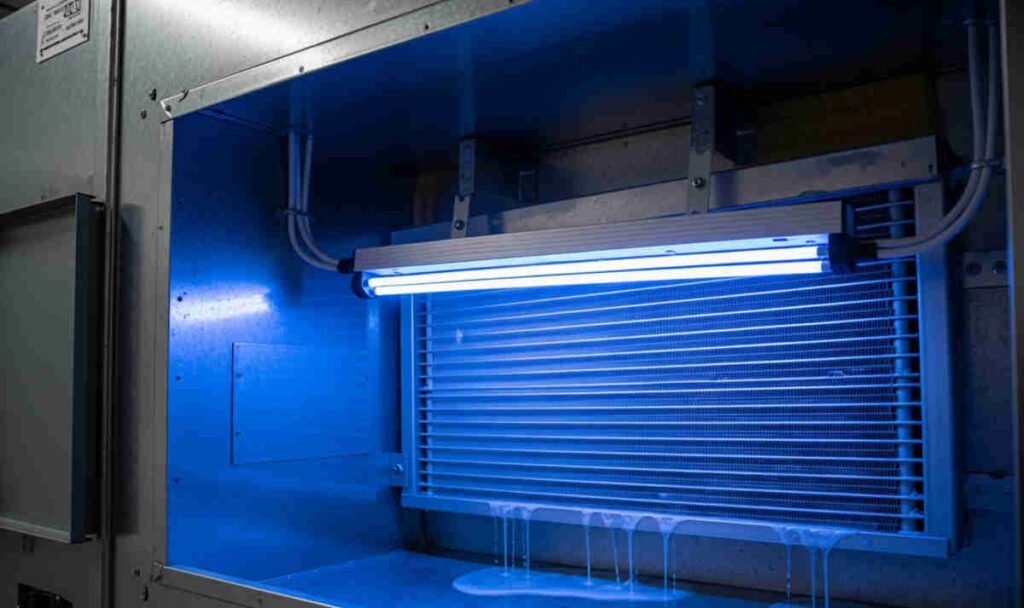
If you found biological growth on the coil, recommend an Ultraviolet (UV) light. Installed directly above the evaporator coil, a UV light disrupts the DNA of mold spores, preventing them from reproducing. This keeps the coil spotless and the air smelling fresh.
The “Best” Option: Whole-Home Dehumidifiers and ERVs
For customers in extremely humid climates, or homes that are sealed so tight that fresh air cannot enter, this is the ultimate solution.
An Energy Recovery Ventilator (ERV) brings in fresh outdoor air while recovering the cooling energy from the exhausted stale air. Installing these requires serious technical skill and a solid understanding of HVAC electrical diagrams.
Why Certifications Matter for IAQ Experts
To confidently offer these high-end solutions, you need to be viewed as an absolute expert. A customer is not going to spend $2,500 on a whole-home purification system if they don’t trust you.
Holding an active <a href=”https://hvacexammaster.com/epa-608/”>EPA 608 Certification</a> proves you are legally compliant. But earning an advanced NATE Certification in Air Distribution or Heat Pumps proves you understand the underlying science of airflow.
When you can confidently explain the relationship between a dirty coil, high static pressure, and elevated mold risks, you transition from a mechanic to an indoor climate consultant.
Conclusion: Stop Leaving Money on the Table
By ignoring indoor air quality, you are leaving thousands of dollars in commission on the table every month.
Offering professional air quality testing sets you apart from the “blow and go” technicians who just top off refrigerant and leave. It shows the homeowner that you care about their health, not just their thermostat.
But remember, you cannot fake this knowledge. You must understand the formulas and the physics behind the air you are testing.
Ready to master the science of airflow?
Stop guessing on the job site. Build your diagnostic confidence by drilling the hardest NATE and EPA questions on our interactive platform.
📱 Turn Theory Into Paychecks
Access 1,500+ updated questions covering psychrometrics, airflow, and advanced diagnostics. Start boosting your industry knowledge today.


0 Comments