HVAC Job Outlook 2026: Will AI Replace Technicians? (Industry Forecast)
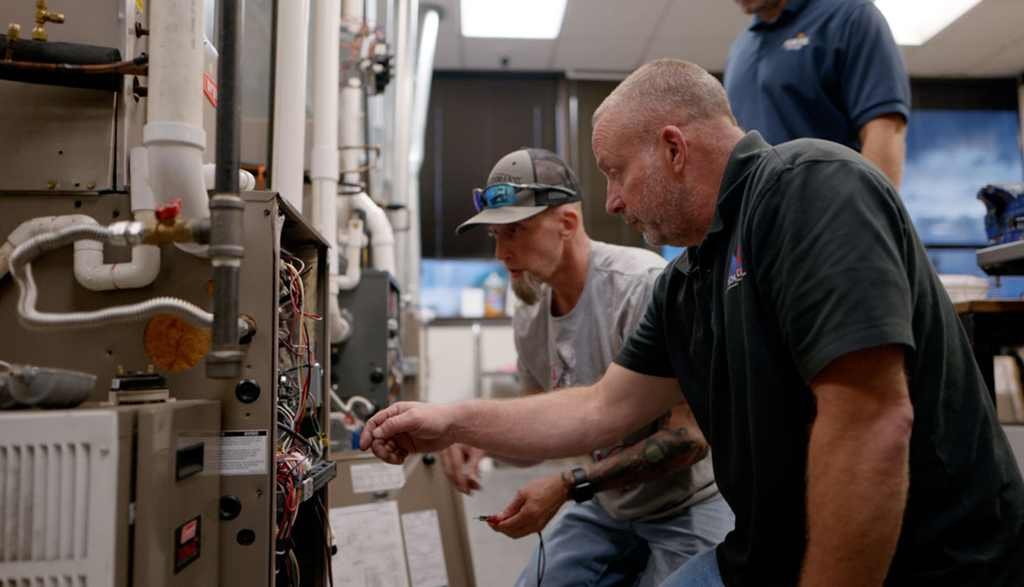
The Future of the Trade: HVAC Job Outlook in 2026
If you are thinking about entering the skilled trades, it is normal to worry about the long-term future. You are likely researching the hvac job outlook to ensure you aren’t investing time and money into a dying profession.
In 2026, the global conversation is dominated by one massive fear: Artificial Intelligence (AI).
Software developers, writers, and even some medical professionals are terrified that AI will steal their jobs. So, what about heating, ventilation, and air conditioning? Will a robot be fixing your customer’s furnace in ten years?
The short answer is absolutely not. In fact, the future has never looked brighter for highly skilled mechanical workers.
In this honest industry forecast, we will break down the official data, explain the massive “vacuum” left by retiring baby boomers, and show you exactly how to future-proof your HVAC salary in the age of smart technology.
📊 Are You Ready for the Future?
Modern HVAC systems require sharp electrical and diagnostic logic. Take our quick aptitude quiz to see if your baseline skills are strong enough.
The Official Data: Is the HVAC Job Outlook Strong?
Before we talk about robots and AI, let’s look at the hard economic numbers.
According to the official projections from the Bureau of Labor Statistics (BLS), the demand for HVAC mechanics and installers is projected to grow by at least 6% over the next decade. This is faster than the average for all other occupations.
Why is the hvac job outlook expanding so rapidly?
- Climate Change: Extreme heat waves and unpredictable winter freezes are forcing homeowners and commercial buildings to upgrade their climate control systems.
- New Regulations: The phase-down of older refrigerants (like R-410A) and the push for highly efficient Green Technology (like heat pumps) means millions of older units must be legally replaced.
- Commercial Infrastructure: Server farms, data centers (which ironically power the AI boom), and logistics warehouses require massive, non-stop industrial refrigeration to prevent overheating.
There is zero doubt that the work will be there. But who is going to do it?
The “Silver Tsunami”: The Retirement Vacuum
The biggest driver of the positive hvac job outlook has nothing to do with technology. It is demographics.
The skilled trades are facing a crisis known as the “Silver Tsunami.” The generation of Master Technicians and experienced journeymen who built the industry over the last 40 years are reaching retirement age.
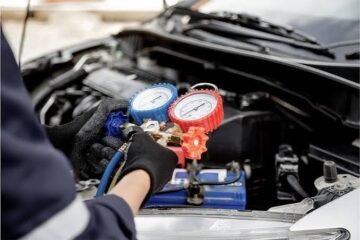
As these baby boomers hang up their manifold gauges, they are leaving a massive vacuum in the workforce.
For every three senior technicians that retire, only one new apprentice is entering the trade school pipeline.
What does this mean for you?
It means absolute leverage. Employers are desperate for reliable, certified talent. If you put in the effort to earn your EPA 608 and study for your state licenses, you will not have to hunt for jobs. Companies will be hunting for you.
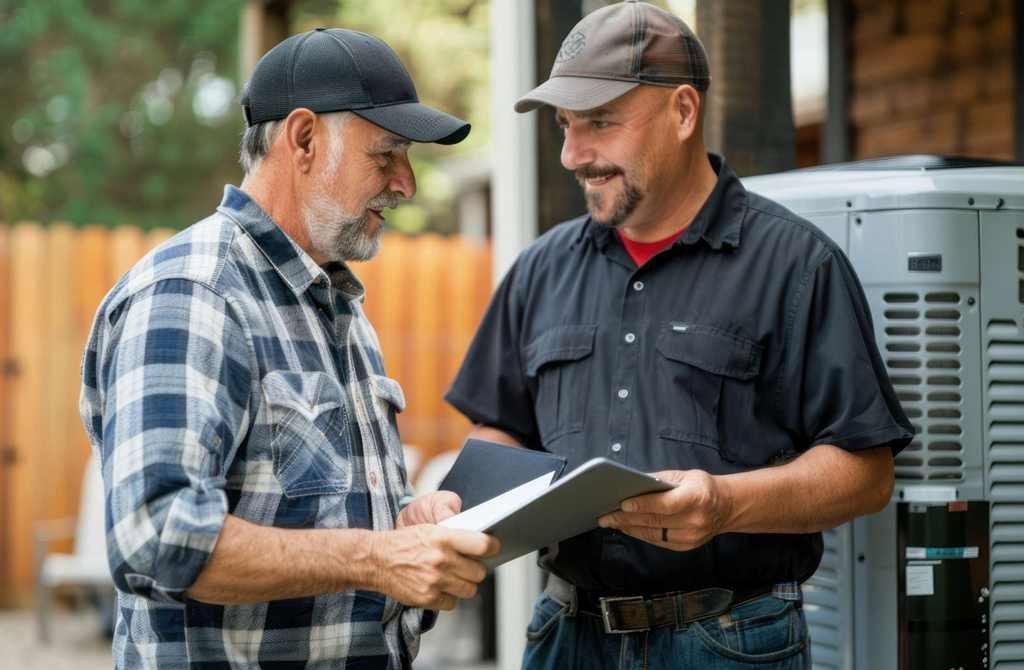
The Elephant in the Room: Will AI Replace Technicians?
Let’s address the anxiety. You see videos of AI writing code and generating images. Will a robot soon be dispatched to a customer’s house to fix a frozen evaporator coil?
Absolutely not.
HVAC is a messy, physical, unpredictable trade. An air conditioner does not exist in a clean, digital environment.
- A robot cannot crawl through a spider-infested, 130-degree attic to find a crushed flex duct.
- AI cannot physically braze a copper joint in the pouring rain.
- Algorithms cannot navigate a flooded basement to replace a rusted condensate pump.
Physical trades are widely considered the hardest jobs to automate. Your hands, your mobility, and your physical adaptability make you completely immune to AI replacement.
How AI Will Actually Change the HVAC Industry
While AI will not replace the technician, it will drastically change how you do your job.
We are already seeing the integration of “Smart Diagnostics” in modern high-efficiency systems. Control boards now feature Bluetooth modules that connect directly to a technician’s smartphone, feeding them live data on superheat, subcooling, and fault codes.
AI will eliminate the guesswork.
In the past, you might spend an hour tracing wires to find a short. In 2026, the smart thermostat and the building automation system (BAS) might literally text you: “Error Code 43: Low voltage short detected on Y-terminal.”
This sounds great, but there is a hidden danger for complacent technicians.
The End of the “Parts Changer”
Because AI and smart boards will soon diagnose the simple problems automatically, the industry will no longer tolerate “Parts Changers.”
A parts changer is a technician who doesn’t understand the underlying physics. They see a frozen coil, guess it’s a bad TXV, swap the part, and hope it works.
If the smart board tells the homeowner exactly what part failed before you even arrive, the homeowner will not pay you $150/hour to just blindly swap it. They are paying you for your mechanical expertise and your ability to fix the root cause.
To secure your future hvac job outlook, you must become an expert in the underlying logic. You must understand why the electrical fault happened, not just that it happened.
This is why advanced certifications are becoming the new standard for employment.
🛠️ Don’t Be a “Parts Changer”
To survive the AI shift, you must understand complex electrical logic. Practice deep troubleshooting scenarios with our interactive simulator.
Future-Proofing Your Career: The NATE Standard
How do you prove to an employer that you are an irreplaceable expert? You earn your NATE Certification.
NATE (North American Technician Excellence) does not test you on basic definitions. It tests you on complex, real-world scenarios. It separates the mechanics from the masters.
As older technicians retire and complex, eco-friendly systems flood the market, employers are offering massive signing bonuses to technicians who hold NATE badges. It is the ultimate shield against any economic downturn.
Conclusion: The Safest Bet You Can Make
The hvac job outlook is arguably the strongest of any blue-collar profession today.
You do not need to fear AI; you need to embrace it. Let the smart thermostats do the basic math, and focus your energy on mastering electrical schematics, the refrigeration cycle, and mechanical brazing.
If you commit to continuous learning and upgrading your certifications, you will have a highly lucrative, physically active, and robot-proof career for the rest of your life.
Ready to become an irreplaceable expert?
Stop relying on field guesses. Solidify your theoretical foundation today so you can handle whatever advanced technology the future throws at you.
📱 Future-Proof Your HVAC Career
Access 1,500+ advanced diagnostic questions for the NATE and Journeyman exams directly in your browser. Master the logic today.

0 Comments